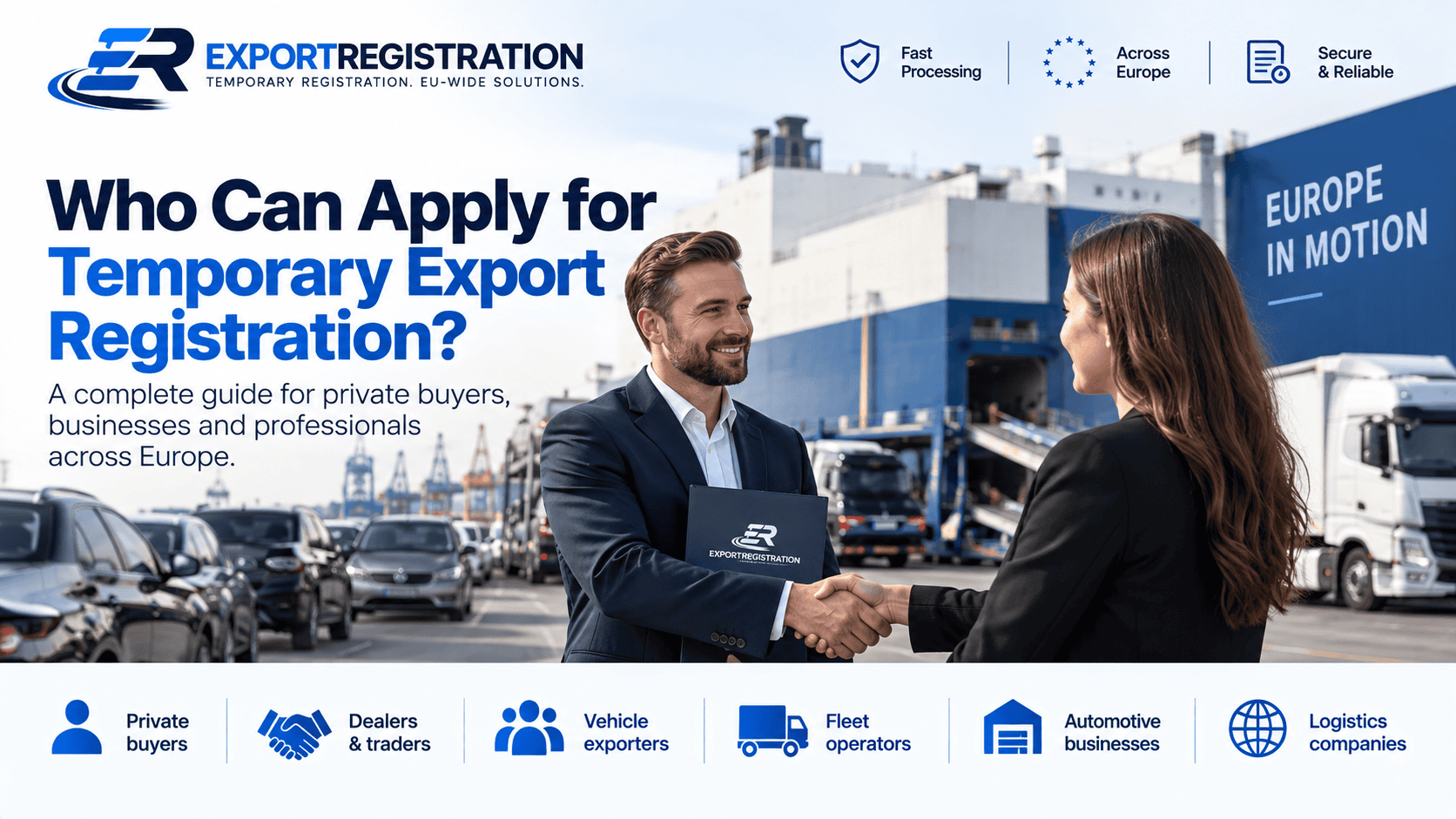
Temporary export registration is used in many different situations. It is not only intended for private buyers who purchase a vehicle abroad. Dealers, vehicle exporters, fleet operators, transport companies and other automotive businesses may also need temporary registration when a vehicle is sold, transferred or moved between countries.
This guide explains who can apply, when temporary export registration may be useful and what responsibilities apply when an application is submitted.
When is temporary export registration used?
Temporary export registration is generally used when a vehicle needs to be driven or transported before permanent registration in the destination country has been completed.
Typical situations include:
Buying a vehicle in another European country
Selling a vehicle to an international buyer
Exporting a vehicle to another country
Moving a company vehicle between countries
Transporting a vehicle before permanent registration
Delivering a vehicle to an international customer
Relocating a vehicle as part of a fleet
Moving a trailer, caravan or commercial vehicle between countries
The exact registration requirements depend on the vehicle, country of registration, destination and route.
Private buyers
Private customers can apply for temporary export registration when they purchase a vehicle abroad and need a temporary registration to move it to another country.
For example, a customer may purchase a vehicle from a dealer in one country and intend to permanently register it in another.
Before applying, the buyer should normally have access to the relevant vehicle documents and proof of purchase.
Depending on the registration procedure, the buyer may need to provide:
A valid passport or identity document
Purchase or sales invoice
Vehicle registration documents
Vehicle identification number (VIN)
Buyer and seller details
Address and contact information
Any additional documents required for the selected registration
Temporary insurance may also be required before the vehicle is used on public roads.
Customers buying from a dealership
Many international vehicle purchases take place through professional dealerships.
In these cases, the temporary registration may allow the buyer to collect or transport the vehicle before permanent registration has been completed in the destination country.
The dealership should provide the correct vehicle and sales documentation.
The buyer remains responsible for ensuring that the vehicle is legally permitted to travel through the countries involved.
Vehicle dealers and traders
Professional vehicle dealers frequently sell vehicles to international customers.
Temporary export registration can help bridge the period between the sale of the vehicle and permanent registration by the buyer.
Dealers may submit applications for individual vehicles or use the service repeatedly for international sales.
For professional customers, it is particularly important that:
Vehicle details are entered correctly
The VIN matches the registration documents
Buyer information is complete
Sales documentation is accurate
The applicant is authorised to submit the documents
Insurance arrangements are confirmed before the vehicle is used
Professional vehicle exporters
Vehicle exporters often process larger numbers of international transactions.
They may purchase vehicles from dealers, auctions, leasing companies, fleet operators or private sellers and then resell those vehicles in other countries.
Temporary export registration can form part of the export process where a vehicle needs to be driven or transported before permanent registration.
Professional exporters should maintain accurate records for each individual vehicle and customer.
Applications should never be submitted using documents from another vehicle or customer.
Automotive businesses
Temporary export registration can also be relevant for a wide range of automotive businesses.
This may include:
Vehicle dealerships
Used-car traders
Truck dealers
Commercial vehicle companies
Leasing companies
Fleet management companies
Vehicle auction businesses
Vehicle transport companies
Logistics providers
International vehicle exporters
These businesses may apply for their own vehicles or, where properly authorised, on behalf of their customers.
Fleet operators
Fleet operators may need temporary registration when vehicles are:
Sold at the end of a lease
Transferred to another country
Moved between company locations
Exported after fleet replacement
Delivered to a new owner
Because fleet transactions may involve multiple vehicles, accurate vehicle administration is especially important.
Each temporary registration is linked to a specific vehicle and must not be transferred to another vehicle.
Transport and logistics companies
Transport and logistics businesses are often involved in international vehicle movements.
However, the transport company is not automatically the owner or buyer of the vehicle.
Where a logistics company submits an application on behalf of another person or business, it must have the necessary authority to do so.
The relevant customer or vehicle owner remains responsible for providing correct documents and information.
Can an employee apply for a company?
Yes, an employee or representative may be able to submit an application on behalf of a company when they are authorised to do so.
Additional company information or authorisation may be requested where necessary.
The applicant should ensure that the person or company named in the application matches the supporting documents.
Can someone apply on behalf of another private person?
In some cases, yes.
A representative may be able to assist another person with the application, but they must have permission to act on behalf of the buyer or owner.
Depending on the registration procedure, a signed mandate or other proof of authorisation may be required.
Who is responsible for the information in the application?
The applicant is responsible for ensuring that all information and documents submitted are accurate and genuine.
This includes:
Names
Addresses
VIN or chassis number
Vehicle registration details
Buyer details
Seller details
Invoices
Identity documents
Authorisations
Insurance information
Incorrect information can result in delays, rejection, additional costs or problems during roadside checks.
Who is responsible for insurance?
Valid motor insurance must be in force before a vehicle is used on public roads.
Where temporary insurance is available through ExportRegistration, the customer may select that option.
If the customer does not purchase insurance through ExportRegistration, the customer remains responsible for arranging valid insurance independently.
The applicant should check:
Insurance start date
Insurance expiry date
Vehicle details
Registration number where applicable
Territorial coverage
Countries in which the insurance is valid
Any policy exclusions
A registration document or licence plate is not proof that valid insurance exists.
Who is responsible for checking foreign rules?
The person using or transporting the vehicle remains responsible for checking the rules in every country involved in the journey.
Temporary registration systems are not completely harmonised throughout Europe.
A registration that has been issued correctly in one country may be subject to different rules or enforcement practices elsewhere.
Before travelling, customers should check whether their:
Temporary registration
Licence plates
Insurance
Vehicle documents
Technical inspection
Vehicle condition
comply with the requirements of each country on the route.
Can an application be refused?
Yes.
An application may be refused, delayed or suspended when:
Documents are missing
Documents cannot be read clearly
Information does not match
The VIN is incorrect
Ownership cannot be demonstrated
Authorisation is missing
Fraud or document manipulation is suspected
An insurer or registration authority rejects the application
Submitting an application does not automatically guarantee approval.
Can businesses submit multiple applications?
Yes.
Professional customers such as dealers, exporters and fleet operators may submit applications for multiple vehicles.
Each vehicle must still have its own correct documentation and vehicle information.
ExportRegistration can support both individual customers and professional customers handling larger volumes of vehicle registrations.
What vehicles can be included?
Depending on the available registration procedure, ExportRegistration can assist with different vehicle categories, including:
Cars
Vans
Trucks
Trailers
Semi-trailers
Caravans
Different vehicle categories may require different documentation.
For more information, read our guide:
Which Vehicles Can You Register for Temporary Export Registration?
What documents are normally required?
The exact documents depend on the vehicle and registration procedure.
Commonly requested information includes:
Identification document
Purchase or sales invoice
Vehicle registration documents
VIN or chassis number
Buyer information
Seller information
Contact details
Company information where applicable
Authorisation documents where required
For a more detailed checklist, read:
What Documents Do You Need for a Temporary Export Registration?
How long does the process take?
A complete application is generally processed within 24 hours.
The processing time may be longer if documents are incomplete, additional checks are necessary or an external registration or insurance partner requires further information.
Providing clear and complete documents from the beginning is one of the best ways to avoid delays.
Can licence plates be collected or delivered?
Where physical export licence plates are available, collection may be possible.
Plates may also be sent by express courier.
Delivery time is separate from registration processing time and depends on the selected delivery method and courier.
Who should use ExportRegistration?
ExportRegistration is designed for customers who want a structured online process for temporary vehicle registration.
This includes:
Private vehicle buyers
International buyers
Car dealers
Commercial vehicle dealers
Vehicle exporters
Fleet operators
Automotive businesses
Logistics companies
Transport companies
Professional vehicle traders
Start your application
Whether you are purchasing one vehicle abroad or regularly exporting vehicles as part of your business, preparing the correct information in advance helps make the registration process faster and easier.
You can start the application online, upload the required documents securely and select the available registration, insurance and plate options for your vehicle.
Start your application at ExportRegistration.com
Frequently asked questions
Yes. Private buyers may apply when they need to move a vehicle before permanent registration is completed, provided the required vehicle and identification documents are available.
Yes. Car dealers and vehicle traders can use temporary export registration for vehicles they purchase, sell or move across European borders.
Yes. Businesses that handle several vehicles can submit separate applications for each vehicle, with the relevant VIN, vehicle documents, buyer details and registration information.
In many cases, yes. If the buyer already has the required purchase documents, VIN and vehicle registration information, the application can often be started before collection.
Yes, an authorised representative can usually submit an application on behalf of a company, provided the correct company details and any required authorisation are supplied.
You will generally need documentation showing the purchase, ownership or authorised right to register the vehicle. The exact documents required depend on the registration procedure.
Yes. Professional vehicle exporters regularly use temporary registration when vehicles need to be moved before their final registration in another country.
 English
 Dutch
 German
 French
 Serbian
 Portuguese
 Ukrainian
 Polish
 Romanian
 Spanish
 Italian