Category: Export guide

  • A plate on the car: three checks at a dealer handover

    The front and rear photographs taken at Vlashuizen show the same Alfa Romeo with pink French WW plates. For someone collecting a car, the useful detail is the one you can check for yourself: the registration number on the front matches the one on the back. At a busy handover, go one step further and compare both with the registration document for the car in front of you.

    Front view of an Alfa Romeo with a pink French WW plate at Vlashuizen.
    Front view of an Alfa Romeo with a pink French WW plate at Vlashuizen.

    Start at the vehicle

    Ask the person handing over the keys to show you the vehicle identification number. Compare it with the vehicle details in your paperwork. Then read the registration number directly from the car and check it against the certificate. This is especially worthwhile when several similar cars are leaving the same forecourt.

    Give the driver the journey details

    Rear view of the same Alfa Romeo at Vlashuizen.
    Rear view of the same Alfa Romeo at Vlashuizen.

    A photograph is a useful record of how the car looked at handover. It cannot tell a driver whether insurance covers a particular journey. Confirm cover for the driver, travel dates and countries on the route with the insurer. Read the dates on the registration document itself. If someone else arranged the paperwork, make sure the person actually collecting the car has the instructions and knows whom to call if something does not match.

    Start at the front and finish with the paperwork

    The first photograph shows the Alfa Romeo facing the camera. The second shows the rear of the same car. Follow that sequence at your own handover. Work through one vehicle from start to finish instead of collecting several sets of keys and trying to identify the right cars afterwards. Take the document folder outside. Read the front plate, walk around and read the rear plate, then hold the paperwork alongside it. In a minute you have made a comparison that a photograph taken from one angle cannot give you.

    Similar-looking characters and transposed digits are easy to miss in conversation. If there is any doubt, have one person read the number aloud while another follows it on the document. Directions such as “the grey one with the pink plates” quickly become ambiguous on a forecourt with several grey cars. The vehicle identification number, often shortened to VIN, gives you another reference for matching the folder to the car. Ask to see it on the vehicle while the person responsible for handover is still with you.

    Decide who will check what

    Imagine that the buyer made the arrangements but a colleague or family member will collect the car. The collecting driver can check whether a plate matches the document in front of them. They may have no idea which journey the buyer discussed with the insurer. Before collection, give them the seller’s contact name, the agreed time and the instructions about the paperwork they should receive. If another person will share the driving or the route changes, discuss that change with the insurer before setting off on the revised journey.

    The same division of responsibilities matters on the seller’s side. One employee may have put the plates with the vehicle while somebody else is handing over the keys. Ask to see the documents when you are standing together at the car. The person who received an email attachment may have finished work by the time the driver arrives. A named contact who can answer a question about the file is more useful at that point than a series of photos scattered across different group chats.

    If a detail looks wrong at collection

    Imagine two neighbouring digits appear in one order on the paperwork and in the opposite order on the car. Describe exactly what you see. Tell the person responsible which document you have open and whether the discrepancy concerns the front plate, the rear plate or both. Keep the items together and ask whoever arranged the registration to compare the details. Decide about departure once you know which item belongs with the vehicle. A tight appointment with the next customer is a reason to call that customer, but it cannot resolve a discrepancy in the paperwork.

    The last five minutes beside the car

    Just before departure the keys often change hands more than once. Use that moment to go through the folder with the person who will be driving. Ask them to point out the vehicle document and make sure they know where to find the insurance information for this journey. If the buyer and the driver are different people, agree who will keep the paperwork after arrival. Check together whether the seller still needs to hand over any originals that you have only seen digitally. Finally, give the driver the contact details of the employee responsible. If anything turns out to be missing at the destination, they will know whom to call without having to explain the whole collection to a stranger.

    Start your export registration application.

    Frequently asked questions about dealer handovers

    Is the Alfa Romeo in these photographs the Mercedes imported from Dubai?

    The photographs taken at Vlashuizen show an Alfa Romeo from the front and rear. The Dubai registration case concerned a Mercedes-Benz C63 AMG. The Alfa photographs illustrate the details you can check by walking around a car. To establish the history of an imported vehicle you need to examine the records that belong to that particular vehicle.

    Where can I find the VIN to compare it with the documents?

    Ask the seller to point out the number on the car. Its location can vary from one vehicle to another. Have the document in your hand so you can compare the characters directly. A photograph sent by the seller only identifies the number in the picture. At a handover you want to identify the vehicle that is actually standing in front of you.

    What information should I give the person collecting on my behalf?

    Give them the agreed vehicle details, the address, the correct entrance and the name of the person holding the keys. Decide who will be available to answer questions about registration and insurance. If your colleague will drive the vehicle, ask the insurer in advance whether the cover applies to that person and the proposed trip.

    Is it worth taking photographs at handover?

    A photograph can help you recall which plates were fitted when the car was collected. Take it beside the relevant vehicle and keep it with its own file. For a picture you intend to share publicly, the vehicle itself is usually enough. Frame the picture so that paperwork on a dashboard does not reveal someone’s name, address or document numbers.

    What happens if my driver reaches the dealership after the agreed time?

    Contact the person responsible for handover at the site. Check whether someone will still be there who can release both the keys and the correct vehicle documents. Arrange another time if the papers are locked away or the responsible colleague has left. The driver can then decide whether it still makes sense to travel to the forecourt that day.

  • A Mercedes-Benz C63 AMG from Dubai: how we prepared the registration file

    The Mercedes-Benz C63 AMG was built in Germany in 2012, previously registered in Dubai and already in the Netherlands by the time the owner approached us. Which part of that history mattered most? For the French temporary registration application, we needed to show how the documents connected this particular car to the applicant. The place of manufacture alone could not answer that question.

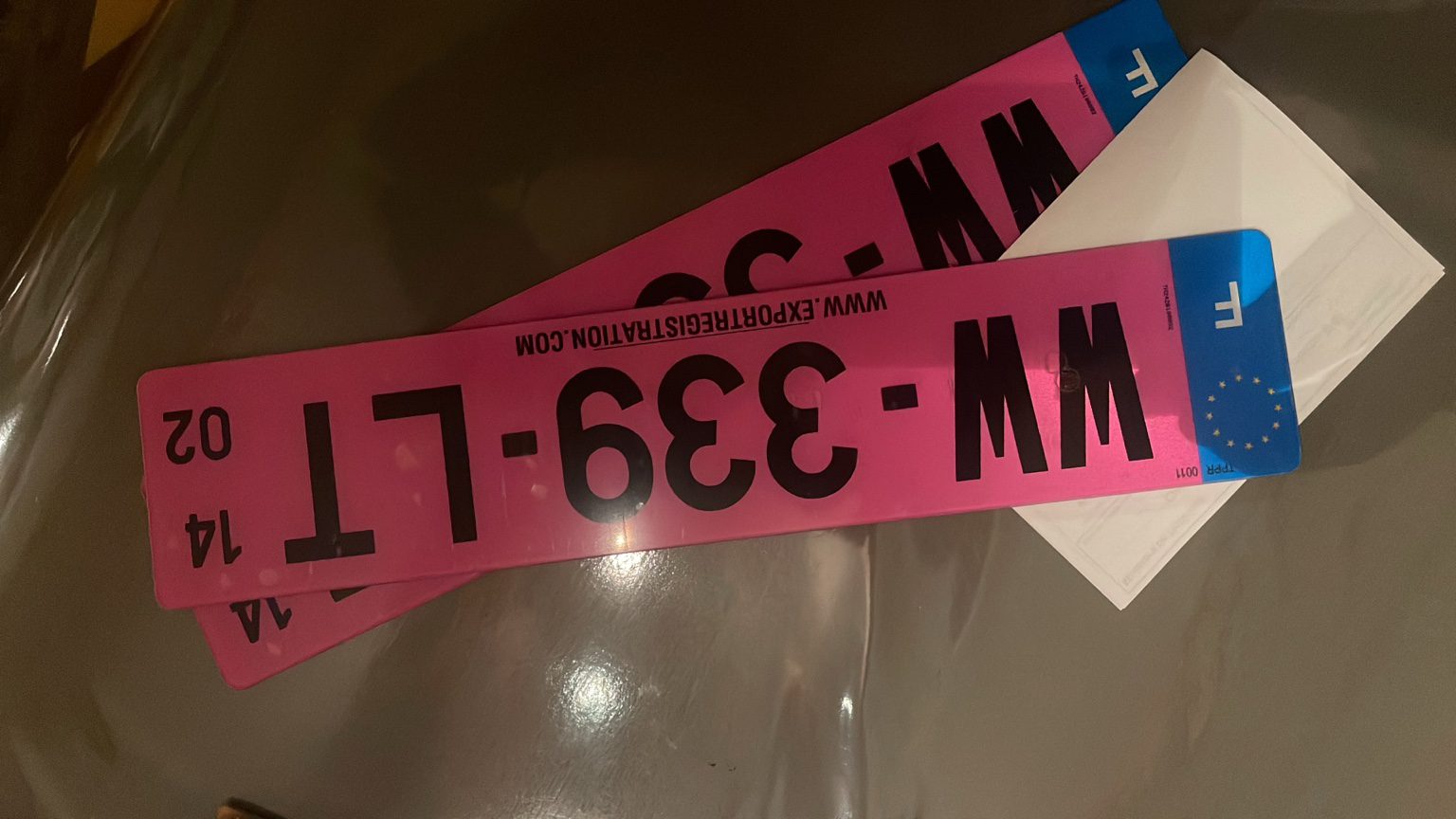
    Finished French WW plates.
    Example of finished French WW plates.

    What the Dubai documents told us

    We started with the Dubai export certificate, the purchase invoice and the available Dutch customs paperwork. Each answered a different question. The export certificate documented the car’s departure from Dubai. The invoice identified the purchase. The customs record concerned the import into the Netherlands. We checked these alongside the applicant’s identification and business documents, then assembled the material for our French registration partner.

    One practical difficulty was an old customs copy that was hard to read. We kept it exactly as supplied. Alongside it we sent an enlarged copy with better contrast and a note explaining the difference. A reviewer could consult the original and see which details were legible. We left unreadable entries as they were.

    Why we asked about type approval separately

    We also asked a specialist whether European type-approval documentation was available for this particular Mercedes. Knowing the model and factory location was a starting point. The outstanding question concerned the actual vehicle. This mattered because the owner’s immediate request for temporary registration and the requirements for permanent registration were two separate issues.

    On 28 October we sent the available paperwork to our French partner for a provisional WW registration certificate, known as a CPI WW. On 29 October the partner sent an acknowledgement. For someone preparing a similar application, the most useful first step is to lay out the car’s history in order: previous registration, export, purchase, import and present location. Tell us which records you have for each stage. We can then assess the available route for your vehicle.

    Reconstruct the history of the actual car

    The paperwork for a used car rarely arrives in a single folder. The seller has the invoice, the importer has the customs papers and there may still be an old registration document in the glovebox. Three countries featured in the history of this Mercedes. It had been built in Germany, registered in the United Arab Emirates and brought into the Netherlands. Describing it simply as a German Mercedes would leave a reviewer wondering why the file contained an export certificate from Dubai. A short timeline makes those connections much easier to follow.

    One way to start is to make four columns on a sheet of paper. For each document, write down who issued it, which vehicle it concerns, which event it records and what remains unclear. On the invoice, for example, check the relationship between buyer and seller. On the export certificate, look for the details that identify the car. If a character is hard to read, record the uncertainty. You now have a specific question to put to the seller or the person who issued the document.

    What our French partner needed to establish

    A business was applying in this case. That meant there was a question about who was acting on the company’s behalf as well as a question about the vehicle itself. Our French partner asked for clarification about the company stamp on the mandate. A sharper image of the car’s identification number would do nothing to resolve a question about a signature. We therefore kept the company records, the mandate and the vehicle documents clearly distinguishable when preparing our response.

    The available material went to the partner in three readable PDF files. One included the old customs copy, the more readable version and the explanation of how the two related. That distinction matters when someone reviewing an application remotely has to determine whether a faint character was actually present in the original. Anyone scanning documents at home can take a similar approach. Keep the whole sheet in the frame, include the reverse if it contains information and save the original file separately.

    What to ask the seller before you collect

    Find out which purchase and export documents come with the car and who can help later if a page is missing. If a reference on an old copy is difficult to make out, ask whether the issuer can supply a clearer copy. Also tell us what you need the registration for. Preparing to move the vehicle temporarily and obtaining permanent registration where you live are separate jobs. A reviewer needs to know which of those questions you are asking before deciding what to examine.

    Read our guide to temporary registration for vehicles from outside the EU.

    RDW guidance on approval for imported vehicles.

    Start your export registration application.

    Frequently asked questions about a car from Dubai

    My car was built in Germany. Which country should I put on the application?

    Give both the country of manufacture and the country of previous registration if you know them. Add the car’s current location. For the C63, this explained why details of a German-built vehicle, an export certificate from Dubai and Dutch customs papers all belonged in one file. If part of the history is uncertain, identify the gap so it can be investigated.

    Can I start with an old copy of the customs document?

    You can ask us to assess what is visible on the copy you have. Use the agreed channel to supply the complete, unaltered document and identify the area that is difficult to read. Whether the reviewer can proceed or needs another record depends on the individual file. For this Mercedes, we explained precisely which historical copy was available.

    Why ask for a mandate when a company buys the vehicle?

    The reviewer needs to understand the connection between the applicant, the person signing and the application. Before submitting business documents, establish who is named on the invoice and who signs on behalf of the buyer. If different people handle those roles, tell us at the start. A follow-up question about authority can then reach the person who can answer it.

    How can I check whether European type approval exists for my car?

    Collect any technical documents that belong to this specific vehicle. The vehicle details can be used to enquire what supporting records are available, as we did separately for the Mercedes. For the Dutch procedure, the RDW explains how it assesses imported vehicles that lack European or national type approval and what an individual assessment means.

    When can I plan collection or transport?

    Agree which confirmation you are waiting for. An acknowledgement tells you the file has reached the recipient. To plan a particular drive, establish which registration has been issued, what documents are available and whether your insurer covers the journey. Tell us about any proposed collection date at the outset so that everyone understands how much flexibility the arrangement allows.

  • Temporary Export Plates in Europe: Which Option Is Right for Your Vehicle?

    Temporary Export Plates in Europe: Which Option Is Right for Your Vehicle?

    Moving a vehicle across Europe can require very different registration solutions depending on where the vehicle is located, where it was purchased and where it needs to go.

    France, Germany, Belgium, Austria and the Netherlands all have their own temporary or export registration systems. These systems differ in validity period, documentation requirements, insurance conditions and intended use.

    That is why ExportRegistration.com does not simply offer one type of export plate.

    You provide us with the vehicle details, available documents, current registration, location and destination. We then assess the available routes and help identify the most suitable legal temporary registration option for your situation.

    Depending on the vehicle, this may involve French WW registration, German export plates, Belgian X export plates, Austrian transfer plates or Dutch export registration.

    European Export Plates Compared

    CountryRegistration typeTypical validity
    FranceCPI WW temporary registrationUp to 4 months
    GermanyAusfuhrkennzeichen / ZollkennzeichenDepends on insurance and authority; potentially up to 1 year
    BelgiumX export plateNormally 30 calendar days
    AustriaÜberstellungskennzeichen3 to 21 days
    NetherlandsExport registrationUp to 14 days for driving in the Netherlands after export

    Each system has advantages and limitations. The correct option is therefore determined by the individual vehicle and journey, rather than simply choosing the plate with the longest validity.

    French WW Temporary Registration

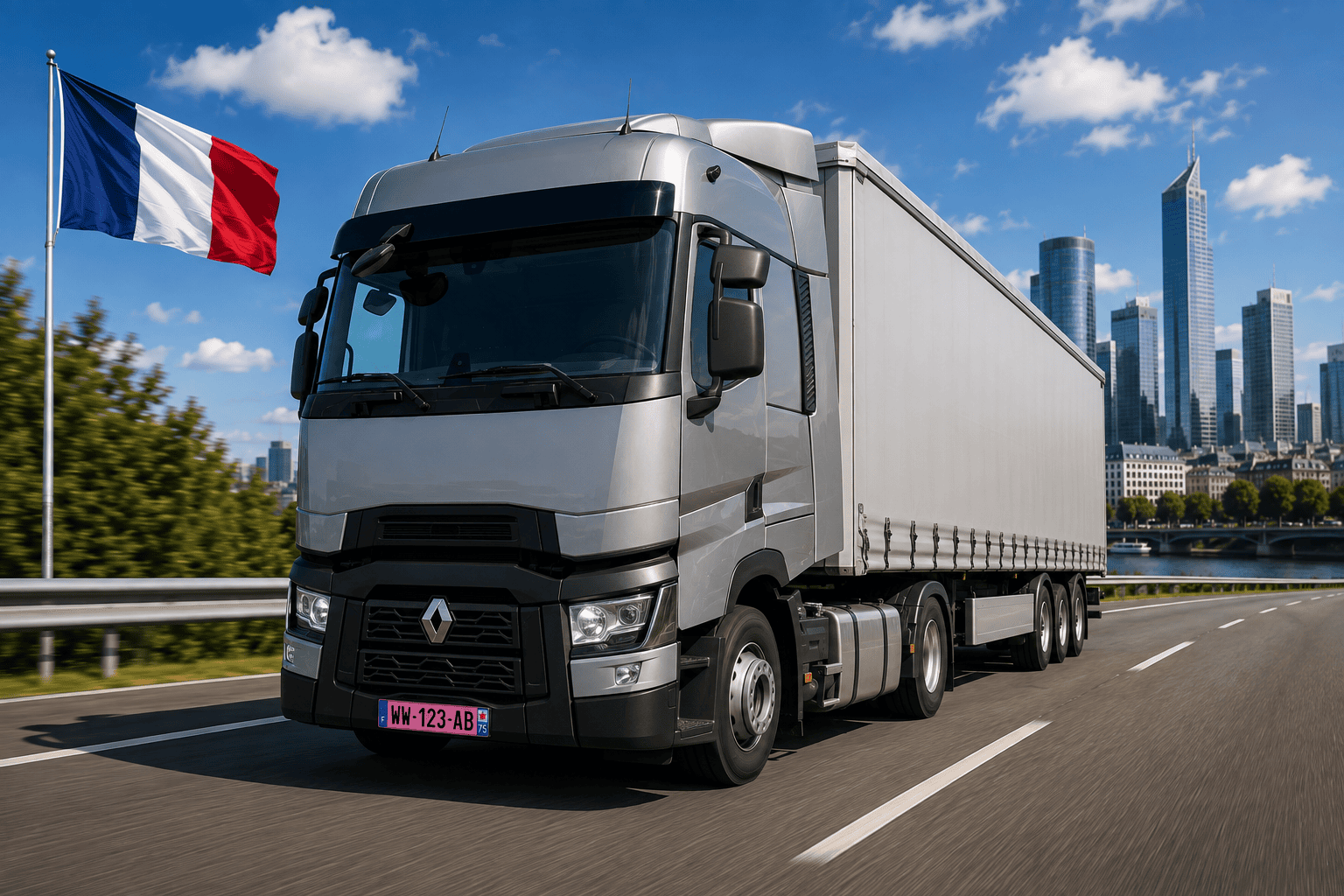
    The French CPI WW is a temporary registration that can be issued for certain imported vehicles and vehicles intended for export.

    A standard CPI WW is valid for 4 months. France also states that use of a French WW abroad remains subject to acceptance by the country where the vehicle is being driven. 

    The longer validity can make a WW registration useful when extra time is required for collection, international transport or permanent registration in the destination country.

    For many international vehicle transactions, four months provides considerably more flexibility than a short-term transfer plate.

    But that does not mean WW registration is automatically the right choice for every vehicle. ExportRegistration.com first checks whether the vehicle and documentation fit the available registration route.

    German Export Plates

    Germany uses the Ausfuhrkennzeichen, also commonly called a Zollkennzeichen or German export plate.

    The German system is specifically designed for vehicles being transferred abroad. Official German information shows that export registration can be issued for a limited period, with the maximum potentially reaching one year. In Berlin, for example, the stated period is between 15 days and one year depending on insurance and the authority’s decision. 

    German export registration has more specific technical requirements than some other systems. A valid German HU inspection may be required for the validity period of the registration. 

    This makes the German option particularly relevant for vehicles already located or registered in Germany, but it is not necessarily the simplest solution in every case.

    Belgian X Export Plates

    Belgium uses the X plate for vehicle export.

    The Belgian mobility authority states that an X plate is normally valid for 30 calendar days, although some specific tax situations can result in a different validity period. 

    The X plate is intended particularly for buyers living abroad who purchase a vehicle in Belgium for export, as well as qualifying foreign legal entities purchasing Belgian vehicles. 

    For a vehicle physically located and purchased in Belgium, an X plate can therefore be a logical export route.

    Austrian Transfer Plates

    Austria uses the Überstellungskennzeichen for the temporary movement of registered and unregistered motor vehicles and trailers.

    Official Austrian information states that these plates are issued for a minimum of 3 days and a maximum of 21 days, and insurance is required for the period in which the plate is used. 

    Austria itself also warns that Austrian transfer plates can sometimes cause difficulties when used abroad, which makes the route and destination important when deciding whether this is the right solution. 

    This is exactly why we look beyond just the price or validity period when selecting a registration route.

    Dutch Export Registration

    The Dutch system works differently.

    When a vehicle already registered in the Netherlands is deregistered for export, its existing Dutch registration numbercan be used on white export plates with black characters.

    After export deregistration, RDW permits the vehicle to be driven on Dutch public roads for up to 14 days. Depending on the type of vehicle, valid insurance and a valid APK may also be required. 

    The Netherlands therefore does not simply issue a new long-term export number comparable with a French WW registration.

    For vehicles without a Dutch registration, the Netherlands also has a separate transit registration, which is valid for 14 days and is intended for vehicles being moved abroad through the Netherlands. 

    Why the Longest Validity Is Not Always the Best Choice

    It may seem logical to simply choose the registration with the longest validity period.

    In practice, that is not how European export registration works.

    A French WW registration may provide up to four months, but the vehicle must fit the conditions for that registration. A German export registration can potentially be valid even longer, but may involve technical inspection and other requirements. Belgian and Austrian registrations are shorter, but may be the appropriate national solution for a vehicle purchased in those countries.

    The best legal option is therefore the option that correctly matches the vehicle, documents, location, destination and intended journey.

    That is the role ExportRegistration.com aims to fulfil.

    You Do Not Need to Choose the Country Yourself

    A customer should not have to understand five different national registration systems before buying a vehicle.

    When you submit your application, we assess information including the vehicle’s current registration, VIN, purchase documents, physical location, destination and intended use.

    Based on the available legal registration routes, ExportRegistration.com helps determine the most suitable option for that specific vehicle.

    One vehicle may be best suited to French WW registration while another may require Dutch, Belgian, German or Austrian registration.

    The solution can therefore differ even when two vehicles are ultimately going to the same destination.

    Especially Useful for Professional Vehicle Traders

    This approach becomes even more important for professional automotive businesses.

    A dealer may purchase several vehicles in different countries in the same week. One truck may come from Germany, three cars from Belgium, another vehicle from an auction in the Netherlands and a van from Austria.

    Using only one national registration solution for every vehicle is not always practical or legally appropriate.

    ExportRegistration.com provides one application process from which the appropriate registration route can be assessed for each individual vehicle.

    This is particularly useful for car dealers, truck traders, auction buyers, exporters, fleet operators and other high-volume automotive businesses.

    Cars, Vans, Trucks, Trailers and Caravans

    The service is not limited to passenger cars.

    Depending on the applicable registration route, ExportRegistration.com can assist with temporary registration solutions for cars, vans, trucks, tractor units, trailers, semi-trailers and caravans.

    Commercial vehicles often have different documentation and insurance requirements from passenger cars, so the vehicle category is taken into account when reviewing the application.

    Registration and Insurance Are Separate

    Regardless of which national registration route is used, temporary registration and motor insurance should always be treated separately.

    A registration can remain valid longer than the insurance attached to the vehicle.

    For example, a temporary registration may remain valid for several months while insurance has only been arranged for part of that period.

    A vehicle may only be driven while appropriate insurance is active.

    One Application, Multiple European Solutions

    ExportRegistration.com is designed to simplify an otherwise fragmented European registration market.

    Instead of asking customers to decide in advance whether they need French, German, Belgian, Austrian or Dutch export plates, the vehicle information can be submitted through one online application.

    We then review the available documents and circumstances and help determine the most suitable legal temporary export registration solution available for the vehicle.

    The objective is not simply to sell a plate.

    The objective is to get the vehicle from its current location to its destination using an appropriate legal registration route.

    Let ExportRegistration.com Find the Right Legal Option

    If you have purchased or sold a vehicle in Europe, submit the vehicle details and available documentation through ExportRegistration.com.

    Tell us where the vehicle is located, where it needs to go and how it will be transported.

    We assess the available options and help identify the most suitable legal solution — whether that involves French WW registration, German export plates, Belgian export plates, Austrian transfer plates or Dutch export registration.

    One application. Multiple European registration solutions. The right route for each vehicle.

    Frequently asked questions

    Do I need to choose which country’s export plates I want?

    Not necessarily. You can submit the vehicle information and documentation to ExportRegistration.com so the available registration routes can be assessed. The appropriate option depends on the vehicle, documents, location and destination.

    Which temporary export registration is valid the longest?

    French CPI WW registration normally has a validity of four months. German export registrations can potentially be issued for longer periods depending on insurance, technical requirements and the competent authority.

    How long is a Belgian X export plate valid?

    A Belgian X export plate is normally valid for 30 calendar days

    How long are Austrian transfer plates valid?

    Austrian temporary export plates are issued for between 3 and 21 days. 

    How long is Dutch export registration valid?

    After a Dutch vehicle is deregistered for export, it can be driven on Dutch public roads for up to 14 days using the export registration, subject to the applicable insurance and inspection requirements.

    Is the cheapest export plate always the best option?

    No. Price is only one factor. The registration must also be legally suitable for the vehicle, documentation, location, route and destination.

    Can ExportRegistration.com find the correct option for a truck?

    Yes. Commercial vehicles may require a different registration route from passenger cars. The vehicle type, documents and intended journey are taken into account when assessing the available options.

    Can different vehicles from the same dealer use different registration systems?

    Yes. A professional trader purchasing vehicles from several European countries may use different registration solutions depending on each vehicle’s circumstances.

    Is insurance automatically included with export registration?

    No. Registration and insurance are separate. The insurance period and geographical cover should always be checked for the intended journey.

    Can I submit my documents online?

    Yes. ExportRegistration.com is designed so vehicle and applicant information can be submitted digitally before the appropriate registration solution is processed.

    Ready to start your application?

    Submit your vehicle and applicant details online and upload the required documents. We will review your information and determine the most suitable temporary export registration solution for your vehicle.

    Fast online application • Secure document upload • Support for private and business customers

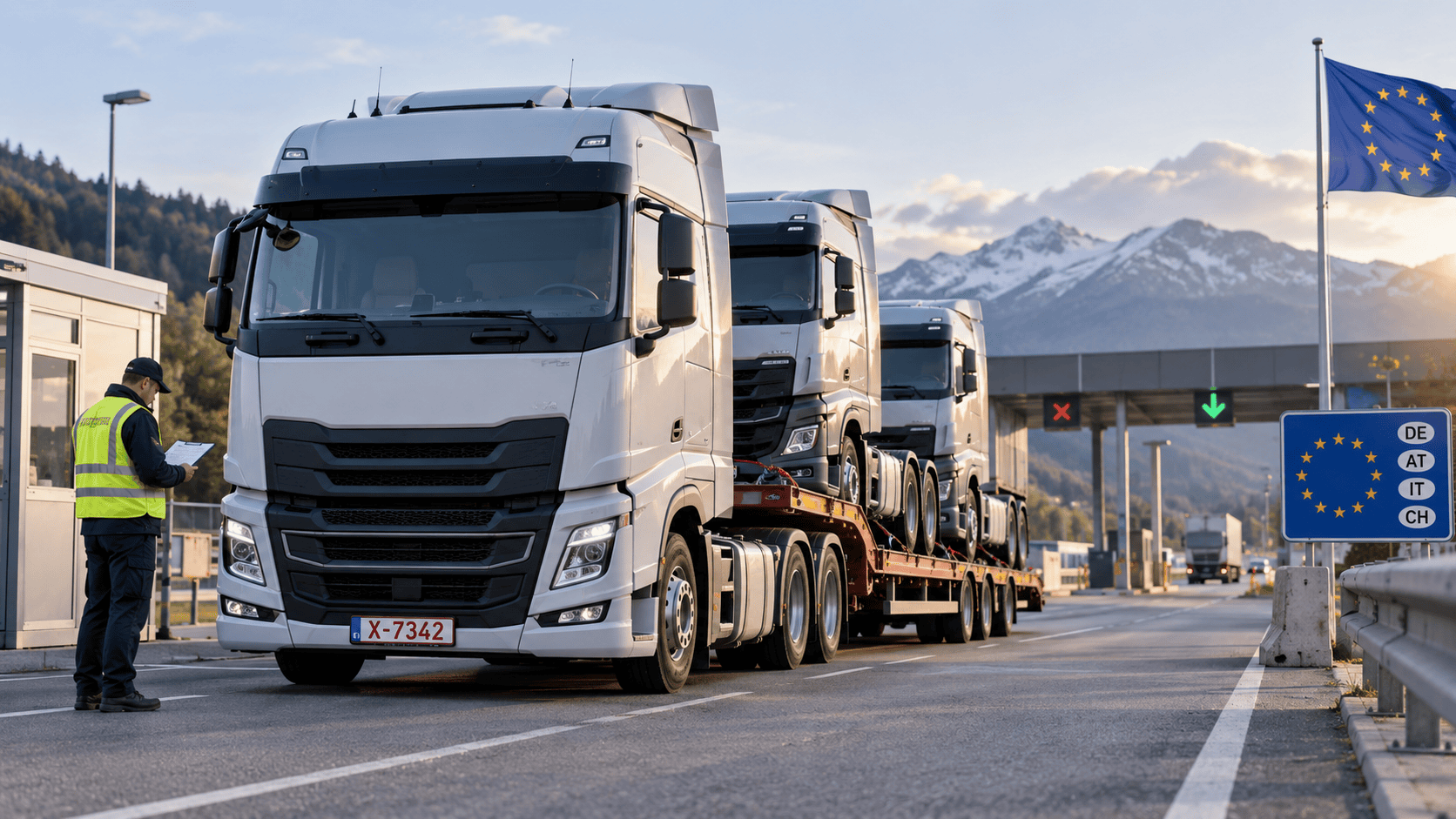
  • Temporary Export Registration for Trucks in Europe

    Temporary Export Registration for Trucks in Europe

    The European truck market is highly international. Used trucks are purchased every day by dealers, transport companies and exporters in one country and transported to customers in another.

    A truck may be sold in the Netherlands, Belgium, Germany or another European country while the final buyer is located hundreds or even thousands of kilometres away.

    Before that vehicle can reach its destination, the buyer or seller needs to decide how the truck will be moved.

    When the existing registration can no longer be used, temporary export registration for trucks can provide an efficient solution.

    ExportRegistration.com helps truck dealers, commercial vehicle traders and exporters arrange temporary vehicle registration online.

    Why Truck Traders Need Temporary Export Registration

    Truck trading differs from ordinary passenger-car sales.

    Commercial vehicles are often sold directly between businesses and may need to travel long distances immediately after purchase. A buyer may want to collect a truck from a dealer and drive it directly to another European country.

    The original registration, however, may no longer be available or legally usable after the sale.

    Temporary export registration can bridge the period between the commercial sale and permanent registration in the destination country.

    Which Commercial Vehicles Can Be Registered?

    ExportRegistration.com can process applications for different commercial vehicle categories.

    This includes trucks and other eligible commercial vehicles, as well as trailers and semi-trailers.

    The correct vehicle category should always be selected when submitting an application because documentation and insurance requirements can differ between vehicle types.

    Temporary Registration for Tractor Units

    Tractor units are frequently traded internationally.

    A tractor unit may be sold separately from its semi-trailer and collected by a professional driver before receiving permanent registration in its final country.

    Temporary registration can provide a solution for this type of cross-border movement when the required documents are available.

    The VIN, registration documents and purchase invoice should match correctly before the application is submitted.

    Temporary Registration for Trailers and Semi-Trailers

    International truck traders often sell complete combinations, but trucks, trailers and semi-trailers are also regularly sold separately.

    Each registered vehicle or trailer may require its own documentation and registration procedure.

    This makes it important to clearly identify the VIN or chassis number for each unit when submitting an application.

    What Documents Are Needed for Truck Export Registration?

    For a temporary truck registration application through ExportRegistration.com, the required information normally includes:

    • valid identification of the applicant;
    • truck registration documents;
    • purchase invoice or sales agreement;
    • VIN or chassis number;
    • buyer or company information;
    • seller information;
    • company and VAT details where applicable.

    A Certificate of Conformity (COC) is not required for the temporary export registration applications processed through ExportRegistration.com.

    A vehicle inspection certificate is also not required to submit the application.

    Truck Registration Without a Valid Inspection Certificate

    A missing or expired inspection certificate does not prevent an application from being submitted through ExportRegistration.com.

    However, registration and roadworthiness are separate matters.

    If a truck is going to be driven on public roads, the driver and vehicle operator remain responsible for ensuring that the vehicle may legally and safely be driven.

    A truck that is not roadworthy should be transported instead.

    How Long Is Temporary Truck Registration Valid?

    Temporary export registration can be valid for up to 4 months, depending on the registration option used.

    This can be particularly useful in the truck trade because commercial vehicle transactions often involve longer transport distances, export procedures and permanent registration in another country.

    The insurance period should always be checked separately.

    Temporary Registration and Truck Insurance

    Registration and motor insurance are separate.

    If a truck will be driven from the seller to its destination, valid insurance must be active for the journey.

    Commercial trucks can have different insurance requirements from passenger vehicles, so the correct vehicle type must be supplied during the application.

    The registration may remain valid longer than the insurance period. The vehicle may only be driven while valid insurance is in force.

    Apply Before the Truck Is Collected

    Professional truck buyers often already have the required documentation before a driver arrives to collect the vehicle.

    This means the temporary export registration process can often be started in advance.

    Once the purchase invoice, VIN and registration documents are available, these can be uploaded digitally through ExportRegistration.com.

    Preparing the registration before collection can help reduce unnecessary waiting time at the seller’s premises.

    Temporary Export Registration for Truck Dealers

    Truck dealers may process significantly higher vehicle values and larger international transactions than many passenger-car traders.

    A professional registration process therefore needs to be organized and scalable.

    ExportRegistration.com is designed for both individual applications and businesses processing multiple vehicles.

    Each truck receives its own application file containing the relevant vehicle details, VIN, documents, registration information and delivery details.

    High-Volume Truck Export Registration

    Large commercial vehicle dealers and exporters may sell hundreds or even thousands of vehicles internationally each year.

    Manually handling every registration through separate communication channels can quickly become inefficient.

    A digital application process allows vehicle documentation to be collected in a consistent format.

    For high-volume business customers, ExportRegistration.com can provide a structured process for repeated truck, trailer and commercial vehicle applications.

    European Truck Trade and Cross-Border Transport

    European commercial vehicle trading connects dealers, logistics companies and exporters throughout the continent.

    A truck purchased in Northern Europe may ultimately be registered in Southern or Eastern Europe, while other vehicles are purchased for further export outside the EU.

    Temporary export registration can form part of the transport process between the point of sale and the vehicle’s next registration.

    Before travelling, the registration and insurance should always be checked for the intended route.

    Start Your Truck Export Registration Online

    If your company has purchased or sold a truck that needs temporary registration, the application can be started online.

    Upload the vehicle registration documents, purchase invoice and applicant information, provide the VIN and select the required registration option.

    ExportRegistration.com supports both individual truck applications and professional automotive businesses processing commercial vehicles regularly.

    Start your temporary export registration for trucks online with ExportRegistration.com.

    Frequently asked questions

    Can I get temporary export registration for a truck?

    Yes. Trucks can be eligible for temporary export registration when the required vehicle and purchase documents are available.

    Can tractor units be temporarily registered?

    Yes. Tractor units can be processed as commercial vehicles when the necessary registration documents, VIN and purchase information are supplied.

    Can trailers and semi-trailers also be registered?

    Yes. Trailers and semi-trailers can also be eligible for temporary registration. Each unit should be submitted with its own correct vehicle or chassis information.

    Do I need a COC for a truck?

    No. A Certificate of Conformity is not required for temporary export registration applications processed through ExportRegistration.com.

    Does the truck need a valid inspection certificate?

    No inspection certificate is required to submit the temporary registration application. Whether the truck may legally be driven on public roads is a separate matter.

    How long can temporary export registration for a truck be valid?

    Temporary export registration can be valid for up to 4 months, depending on the registration option used.

    Is insurance included automatically?

    No. Temporary registration and truck insurance are separate. Valid insurance must be active whenever the truck is driven on public roads.

    Can I apply before the driver collects the truck?

    In many cases, yes. If the purchase invoice, VIN and registration documents are already available, the application can often be started before collection.

    Can truck dealers submit multiple applications?

    Yes. ExportRegistration.com is designed to support professional vehicle traders and businesses processing multiple commercial vehicle applications.

    Can foreign truck buyers apply online?

    Applications can be started online from another country when the required applicant, purchase and vehicle documentation is available. The applicable registration procedure depends on the vehicle and circumstances.

  • Temporary Export Registration for Auction Cars in Europe

    Temporary Export Registration for Auction Cars in Europe

    Buying vehicles through European car auctions has become increasingly popular among car dealers, exporters and private buyers. Online auctions make it possible to purchase vehicles from another country without visiting the seller before the sale.

    But after winning the auction, one important question remains: how do you get the vehicle home?

    A vehicle purchased at auction may no longer have registration plates that can legally be used by the new owner. In that situation, temporary export registration can provide a solution for collecting and moving the vehicle before permanent registration takes place.

    What Happens After You Buy a Car at Auction?

    After payment has been completed, the auction company or seller normally provides the vehicle documents and purchase information required for collection.

    Before arranging transport, it is important to check whether the vehicle still has a valid registration that may legally be used for the journey.

    In many cases, auction vehicles are deregistered or sold without usable registration plates.

    That means temporary registration or professional vehicle transport may be needed before the vehicle can leave the auction location.

    What Is Temporary Export Registration for an Auction Vehicle?

    Temporary export registration gives the vehicle a temporary registration for a limited period.

    It can be useful when a vehicle has been purchased in one European country and will later receive permanent registration in another country.

    Through ExportRegistration.com, temporary registration can be valid for up to 4 months, depending on the registration option used.

    This provides additional time for collection, cross-border transport and permanent registration at the vehicle’s final destination.

    Which Documents Do You Need?

    The exact documents can depend on the application, but customers will normally need information that identifies both the vehicle and the buyer.

    Commonly required information includes:

    • valid ID or passport;
    • vehicle registration documents;
    • auction invoice or purchase invoice;
    • VIN or chassis number;
    • buyer or company information;
    • address details;
    • company and VAT details for business customers where applicable.

    A Certificate of Conformity (COC) is not required for temporary export registration applications processed through ExportRegistration.com.

    A vehicle inspection certificate is also not required to submit the application.

    Check the VIN Before Applying

    The VIN is one of the most important details in an auction vehicle application.

    Before submitting your registration request, compare the VIN on the auction invoice with the vehicle registration documents.

    The information should match exactly.

    Incorrect VIN information can result in additional verification and may delay processing.

    Can You Apply Before Collecting the Auction Vehicle?

    In many cases, yes.

    Once the auction has supplied the invoice, VIN and vehicle registration documents, the temporary registration application can often be started before travelling to collect the vehicle.

    This can be particularly useful when the auction location is hundreds of kilometres away.

    Preparing the registration in advance can reduce the risk of arriving at the collection location without the documents needed to move the vehicle.

    Temporary Export Plates and Insurance

    Temporary registration and vehicle insurance are separate.

    If the auction vehicle will be driven on public roads, valid insurance must be active for the journey.

    The insurance period should be checked separately from the registration validity period.

    If the vehicle is being transported on a trailer or vehicle transporter instead of being driven, different requirements may apply.

    What If the Auction Vehicle Has No Valid Inspection?

    A valid inspection certificate is not required to submit the temporary export registration application through ExportRegistration.com.

    However, temporary registration does not automatically make a vehicle roadworthy.

    If a vehicle is damaged, unsafe or otherwise not permitted to be driven on public roads, it should be transported rather than driven.

    Temporary Registration for Professional Car Dealers

    Car dealers often purchase multiple vehicles from auctions in different European countries.

    For professional buyers, handling every vehicle through a structured registration process makes administration easier.

    Each vehicle can have its own VIN, auction invoice, registration documents, insurance selection and delivery information.

    ExportRegistration.com supports both individual vehicle applications and businesses processing multiple registrations.

    Online Car Auctions and Cross-Border Vehicle Trading

    Online vehicle auctions have made the European automotive market increasingly international.

    A dealer in one country can purchase a vehicle located hundreds or thousands of kilometres away and arrange collection without ever visiting the auction before purchase.

    That makes temporary registration an important part of cross-border vehicle logistics.

    Preparing the documents before collection helps connect the purchase process with the vehicle’s physical transport.

    Start Your Temporary Export Registration Before Collection

    If you have purchased a vehicle through a European auction, you do not necessarily have to wait until collection before starting the registration process.

    Once the required purchase and vehicle documents are available, you can submit your application online through ExportRegistration.com.

    Upload the documents, provide the VIN and applicant information, and select the required registration option.

    Start your temporary export registration application before collecting your auction vehicle

    Frequently asked questions

    Can I apply for temporary registration for a vehicle bought at auction?

    Yes. Auction vehicles can be eligible for temporary export registration when the required vehicle, purchase and applicant documents are available.

    Do I need the original auction invoice?

    You need documentation confirming the vehicle purchase. A clear digital copy of the auction or purchase invoice can be uploaded as part of the application.

    Can I apply before collecting the car?

    In many cases, yes. If the VIN, invoice and vehicle registration documents are already available, the application can often be started before collection.

    Do I need a COC for an auction vehicle?

    No. A Certificate of Conformity is not required for temporary export registration applications processed through ExportRegistration.com.

    Does the auction vehicle need a valid inspection certificate?

    No inspection certificate is required to submit the temporary export registration application. Whether the vehicle itself may legally be driven is a separate matter.

    How long can temporary export registration be valid?

    Temporary export registration can be valid for up to 4 months, depending on the registration option used.

  • Temporary Vehicle Registration for Car Dealers in Europe

    Temporary Vehicle Registration for Car Dealers in Europe

    Vehicle trading across European borders has become an important part of the automotive market. Dealers regularly purchase cars, vans and commercial vehicles in one country and transport them to another country for resale, export or permanent registration.

    For professional traders, one of the main practical questions is how a newly purchased vehicle can be moved when its previous registration can no longer be used.

    This is where temporary vehicle registration for car dealers can become an important part of the export process.

    At ExportRegistration.com, we help automotive businesses organize temporary registration applications digitally, making it easier to manage vehicles purchased throughout Europe.

    Why Car Dealers Need Temporary Vehicle Registration

    When a dealer purchases a vehicle abroad, the original registration may be cancelled, transferred or otherwise unavailable for the journey.

    The vehicle may still need to travel hundreds or even thousands of kilometres before reaching the dealer, customer or final registration country.

    Temporary registration can provide a registration solution for this period.

    It is particularly useful for businesses that regularly move vehicles between European countries.

    Typical Situations for Vehicle Traders

    Temporary export registration may be relevant when a dealer purchases a vehicle from an auction, another dealership, leasing company or private seller.

    Common situations include:

    • collecting a vehicle purchased abroad;
    • moving stock between European countries;
    • exporting a sold vehicle to an international customer;
    • transporting a vehicle before permanent registration;
    • supplying vehicles to another dealer or importer;
    • moving commercial vehicles that have been deregistered.

    For businesses handling multiple vehicles every month, having a consistent registration process can save considerable administrative time.

    What Information Is Needed?

    A temporary vehicle registration application normally requires information about both the applicant and the vehicle.

    Vehicle details typically include the VIN or chassis number, vehicle category, registration information and purchase documentation.

    The VIN is especially important because it links the vehicle to its registration documents and purchase paperwork.

    Business customers may also need to provide company details and VAT information.

    Additional documentation can be required depending on the vehicle and registration procedure.

    Digital Document Uploads

    Professional vehicle traders often work with vehicles located in different countries.

    A digital application process makes it possible to prepare a registration request before the vehicle arrives at the dealer’s premises.

    Through ExportRegistration.com, customers can upload the necessary vehicle and customer documents online.

    This allows the registration file to be prepared without having to physically exchange paperwork before the application is reviewed.

    Temporary Registration and Vehicle Collection

    Timing is important when purchasing vehicles internationally.

    A transporter, driver or customer may already have a collection appointment scheduled.

    If the necessary registration documents are not ready, the vehicle may have to remain at the seller’s location longer than expected.

    Preparing the temporary registration before collection can make the logistics process more predictable.

    Whenever possible, dealers should collect the required documents from the seller immediately after completing the purchase.

    Temporary Plates for Cars, Vans and Commercial Vehicles

    Professional traders do not only purchase passenger cars.

    A vehicle export business may also handle vans, trucks, trailers and other commercial vehicles.

    Registration requirements can vary according to vehicle category, so the correct type of vehicle should always be selected when submitting an application.

    ExportRegistration.com is designed to support different vehicle categories within one registration process.

    Insurance for Temporary Registration

    Temporary registration and motor insurance must be considered separately.

    A temporary registration does not automatically guarantee that insurance is active for the entire registration period.

    If the vehicle will be driven on public roads, valid insurance must be in place.

    Dealers should therefore verify both the temporary registration period and the insurance period before arranging collection.

    This is particularly important when the vehicle will travel through several countries.

    Managing Multiple Vehicle Registrations

    For a dealer processing one vehicle, registration administration may be relatively simple.

    For a business processing dozens or hundreds of vehicles, organization becomes much more important.

    Each vehicle can have different documentation, VIN numbers, buyers, registration periods, delivery addresses and insurance requirements.

    A structured digital registration process helps keep each application linked to the correct vehicle.

    At ExportRegistration.com, each application can be processed as an individual vehicle file, helping businesses keep registrations organized.

    Temporary Registration for International Vehicle Sales

    Temporary registration is not only useful when buying vehicles.

    Dealers selling vehicles to international customers may also need a temporary registration solution.

    For example, a customer may purchase a vehicle from a dealer and wish to drive it to another European country.

    The permanent registration will usually take place at the final destination.

    Temporary export registration can help bridge the period between the sale and permanent registration.

    A Scalable Solution for Automotive Businesses

    As vehicle trading volumes increase, manual registration processes can become difficult to manage.

    Professional dealers need predictable procedures, clear documentation requirements and a reliable way to process multiple applications.

    ExportRegistration.com is developing its service specifically for both individual applications and high-volume business customers.

    This gives dealers, exporters and automotive companies one place to submit vehicle information, documents and registration requests.

    Start a Business Registration Application

    If your company buys or sells vehicles internationally, temporary registration can help simplify cross-border vehicle movements.

    With ExportRegistration.com, vehicle traders can submit applications online, upload the required documents and manage temporary registration requests digitally.

    Whether you are registering one vehicle or processing multiple vehicles every month, you can start your application through our online registration system.

    Start your temporary vehicle registration application with ExportRegistration.com

    Frequently Asked Questions

    Why do car dealers need temporary vehicle registration?


    Car dealers may need temporary vehicle registration when a vehicle has been purchased or sold across borders and the existing registration can no longer be used. Temporary registration can allow the vehicle to be moved before permanent registration is completed.

    Can a dealer arrange temporary registration before collecting a vehicle?

    In many cases, the application process can be started before collection if the required vehicle documents, purchase information and VIN are already available.

    Is insurance included with temporary vehicle registration?

    Not automatically. Temporary registration and motor insurance are separate. If the vehicle will be driven on public roads, valid insurance must also be in place.

    Can ExportRegistration.com handle multiple vehicles for business customers?

    Yes. ExportRegistration.com is designed for both individual applications and professional vehicle traders who process multiple vehicles. Each vehicle application can be handled separately with its own documents and registration information.

    Can temporary registration be used for cars and vans?

    Yes. Temporary vehicle registration can be relevant for passenger cars, vans and other eligible commercial vehicles. The exact requirements can differ depending on the vehicle category and registration procedure.

    What documents does a car dealer need for temporary vehicle registration?

    Typical requirements may include the vehicle registration documents, purchase invoice or sales agreement, VIN, company details, identification and any additional documents required for the registration procedure.

  • Temporary Export Plates in Europe: How Do They Work?

    Temporary Export Plates in Europe: How Do They Work?

    When a vehicle is sold, purchased or transported across European borders, the existing registration cannot always be used for the journey. In these situations, temporary export plates in Europe can provide a practical solution.

    Temporary export registration allows a vehicle to be registered for a limited period while it is being moved to another country, exported or prepared for permanent registration.

    For private buyers, car dealers and professional vehicle exporters, understanding how temporary registration works can prevent unnecessary problems during cross-border vehicle transport.

    What Are Temporary Export Plates?

    Temporary export plates are registration plates issued for a limited period.

    They are commonly used when a vehicle needs to be driven or transported before receiving its permanent registration in the destination country.

    They may be relevant when:

    • a vehicle has been purchased in another European country;
    • a vehicle is being exported;
    • the previous registration can no longer be used;
    • permanent registration has not yet been completed;
    • a dealer needs to move a recently purchased vehicle across borders.

    The exact procedure depends on the vehicle, available documentation and registration route being used.

    Why Are Temporary Registration Plates Needed?

    A vehicle used on public roads normally needs a valid registration.

    After a sale or export, the vehicle’s previous registration may no longer be available or legally usable by the new owner.

    A temporary vehicle registration bridges the period between purchase and permanent registration.

    This makes temporary export plates especially useful for international vehicle transactions.

    Which Vehicles Can Need Temporary Export Plates?

    Temporary registration is commonly associated with passenger cars, but cross-border registration services can also be relevant for other vehicle categories.

    These can include:

    • cars;
    • vans;
    • commercial vehicles;
    • trucks;
    • trailers;
    • caravans.

    Requirements can differ depending on the vehicle category, so the correct information should always be supplied when submitting an application.

    What Documents May Be Required?

    A temporary export registration application usually requires sufficient documentation to identify the vehicle and applicant.

    Depending on the registration procedure, this can include:

    • vehicle registration documents;
    • purchase invoice or sales agreement;
    • identification document;
    • VIN or chassis number;
    • buyer or company details;
    • address information;
    • Certificate of Conformity, when available;
    • additional supporting documents where required.

    Business customers may also need to provide company and VAT information.

    At ExportRegistration.com, documents can be uploaded digitally as part of the online application.

    What Is a VIN and Why Is It Important?

    The Vehicle Identification Number, or VIN, uniquely identifies a vehicle.

    Most modern vehicles use a 17-character VIN.

    This number should match across the vehicle, registration documents and purchase paperwork.

    An incorrect VIN can lead to a mismatch in the application, which is why it should always be checked carefully before temporary registration is requested.

    How Long Are Temporary Export Plates Valid?

    Temporary registration is issued for a limited period.

    The appropriate validity period depends on the expected journey and the time needed before permanent registration can be completed.

    When choosing a period, consider:

    • vehicle collection;
    • international transport;
    • weekends and public holidays;
    • possible import procedures;
    • permanent registration appointments;
    • unexpected delays.

    Choosing a period that is too short can cause problems if the vehicle has not reached its destination before the registration expires.

    Do Temporary Export Plates Include Insurance?

    Not necessarily.

    Temporary registration and motor insurance are separate.

    A temporary registration plate does not automatically mean that the vehicle has valid insurance for the same period.

    If the vehicle will be driven on public roads, appropriate insurance must be active.

    Before travelling, verify the insurance start date, end date and geographical coverage.

    Can You Arrange Temporary Export Plates Online?

    Depending on the registration procedure, much of the application process can be completed digitally.

    With ExportRegistration.com, applicants can enter vehicle details, upload supporting documents and submit their registration request online.

    This is particularly useful for customers who are purchasing a vehicle abroad and want to prepare the registration before travelling to collect it.

    Temporary Export Plates for Car Dealers

    For professional vehicle traders, temporary registration can become a regular part of the purchasing and export process.

    Dealers buying multiple vehicles across Europe need a clear way to keep each registration application organized.

    A structured process can help manage:

    • vehicle information;
    • VIN numbers;
    • purchase documents;
    • customer details;
    • temporary registration periods;
    • insurance selections;
    • invoices;
    • delivery information.

    ExportRegistration.com also supports business customers processing multiple vehicle registrations.

    Can Temporary Export Plates Be Used Across Europe?

    Temporary registration documents are issued under specific national registration procedures.

    Whether and how they may be used across borders depends on the registration, insurance and countries involved.

    Before starting an international journey, the driver should ensure that the vehicle has the appropriate registration documents and valid insurance for the intended route.

    Temporary Export Plates vs Permanent Registration

    Temporary export plates are not intended to replace permanent vehicle registration.

    Their purpose is to provide a temporary registration solution while the vehicle is being moved, exported or prepared for permanent registration.

    Once the vehicle reaches its destination, the owner will normally need to complete the applicable permanent registration procedure.

    Apply for Temporary Export Registration

    If you have purchased or sold a vehicle that needs to be moved across Europe, temporary export registration may provide the registration solution needed for the journey.

    With ExportRegistration.com, you can start your application online, upload your documents and submit the required vehicle information digitally.

    Start your temporary export registration application online.

    Frequently Asked Questions

    What are temporary export plates?

    Temporary export plates are registration plates issued for a limited period to allow a vehicle to be moved before permanent registration is completed.

    Are temporary export plates the same as insurance?

    No. Vehicle registration and motor insurance are separate. A vehicle driven on public roads must also have valid insurance.

    Can car dealers use temporary export registration?

    Yes. Temporary registration can be useful for dealers and exporters moving vehicles between European countries before final registration.

    Do I need export plates after buying a car abroad?

    That depends on whether the existing registration remains valid and can legally be used by the new owner. If it cannot, temporary registration may be required.

    Can I apply before collecting the vehicle?

    Where the required vehicle and purchase documents are already available, the registration application can often be prepared before collection

  • How to Drive a Car Home From Another EU Country

    How to Drive a Car Home From Another EU Country

    Buying a vehicle in another European country can offer more choice and competitive prices. But after purchasing the vehicle, one important question remains: how can you legally drive a car home from another EU country?

    In many cases, you cannot simply use the seller’s existing registration plates. Depending on the vehicle and circumstances, you may need temporary vehicle registration, export plates and valid insurance before driving the vehicle across borders.

    This guide explains what to check before collecting a vehicle abroad and how temporary registration can help you transport it to its destination.

    Can You Drive a Car Home After Buying It Abroad?

    Not automatically.

    Once a vehicle has been sold, the existing registration or insurance may no longer be valid for the new owner. The exact rules depend on the country where the vehicle is registered and the circumstances of the sale.

    Before driving away, make sure you have a valid method of registration and insurance for the journey.

    For many cross-border vehicle purchases, this means arranging temporary export registration.

    What Is Temporary Export Registration?

    Temporary export registration allows a vehicle to receive temporary registration documents for a limited period.

    It is commonly used when a vehicle has been purchased in one European country but will ultimately be registered permanently in another.

    Temporary registration can provide the time needed to:

    • collect the vehicle from the seller;
    • drive or transport it across borders;
    • complete import procedures;
    • arrange permanent registration in the destination country.

    At ExportRegistration.com, vehicle owners and traders can submit temporary registration applications online.

    What Documents Do You Need?

    The exact documentation can vary, but a temporary vehicle registration application will commonly require information such as:

    • buyer or company details;
    • identification document;
    • vehicle registration documents;
    • purchase invoice or sales agreement;
    • VIN or chassis number;
    • Certificate of Conformity when available;
    • address details;
    • additional documents depending on the vehicle and registration procedure.

    Providing complete and clearly readable documents helps the application move through the verification process efficiently.

    Always Check the VIN Before Collection

    A modern Vehicle Identification Number normally contains 17 characters.

    Before submitting an application, compare the VIN entered online with:

    1. the vehicle itself;
    2. the registration certificate;
    3. the purchase invoice.

    Even a small difference can create problems when vehicle information is checked.

    For this reason, ExportRegistration.com verifies the VIN information provided as part of the application process.

    Do You Need Export Plates?

    If a vehicle is no longer legally allowed to use its previous registration plates, temporary or export plates may be needed before it can be driven.

    These plates are linked to temporary registration documentation and are intended for vehicle movement during the period before permanent registration.

    The exact solution depends on the vehicle, documentation and route.

    You can view the available registration options on our Temporary Export Registration Prices page.

    Temporary Registration and Insurance Are Different

    One of the most important things to understand when buying a car abroad is that temporary registration and vehicle insurance are separate.

    A registration document being valid for a certain period does not automatically mean the vehicle is insured for that entire period.

    Before driving the vehicle, check that valid insurance is in force for the journey and the countries through which the vehicle will travel.

    Customers who arrange their own insurance remain responsible for ensuring that appropriate cover is active before using the vehicle on public roads.

    Should You Drive the Vehicle or Use a Transporter?

    There are generally two options for moving a recently purchased vehicle.

    Drive the vehicle home

    This may be practical when temporary registration and valid insurance have already been arranged.

    Before departure, check all documents and make sure the temporary registration remains valid for the expected journey.

    Transport the vehicle

    A transporter or trailer may be preferable when the vehicle cannot yet legally be driven or when registration and insurance have not been arranged.

    Professional vehicle traders often combine both options depending on destination, vehicle value and delivery schedule.

    Buying Cars Abroad as a Vehicle Trader

    Temporary registration is especially relevant for companies purchasing vehicles regularly across Europe.

    Car dealers, exporters, fleet companies and automotive traders may process multiple vehicles every week.

    Using a structured registration service can make it easier to manage:

    • individual vehicle dossiers;
    • VIN numbers;
    • customer and seller information;
    • registration documents;
    • temporary plates;
    • insurance choices;
    • invoices;
    • delivery information.

    ExportRegistration.com also offers solutions specifically for business customers and high-volume vehicle registrations.

    How Long Should Temporary Registration Be Valid?

    Choose a validity period that gives enough time for the complete journey and the next stage of registration.

    Consider:

    • vehicle collection date;
    • international transport time;
    • weekends and holidays;
    • possible import procedures;
    • appointment availability in the destination country;
    • time needed for permanent registration.

    Choosing too short a period can create unnecessary problems if the process takes longer than expected.

    Apply Before Travelling to Collect the Vehicle

    Where possible, arrange the necessary documentation before travelling to the seller.

    That allows you to identify missing documents before collection and reduces the risk of arriving abroad with a vehicle that cannot legally be driven home.

    With ExportRegistration.com, the application process can be started online and supporting documents can be uploaded digitally.

    Start Your Temporary Registration Application

    If you have purchased a vehicle abroad and need temporary registration to move it across Europe, you can start your application online.

    Upload the required vehicle documents, enter the VIN and customer information, select the required registration period and submit your application.

    Start your temporary registration application with ExportRegistration.com.

    Frequently asked questions

    Can I drive a car home after buying it in another EU country?

    Only when the vehicle has valid registration and insurance for the journey. Depending on the situation, temporary export registration may be required.


    Do I need temporary export plates to drive a purchased car home?

    This depends on the current registration status of the vehicle and the countries involved. If the existing registration cannot legally be used, temporary or export plates may be necessary.

    Can I arrange temporary registration before collecting the vehicle?

    In many cases, the application process can be started before collection once the required vehicle and purchase documents are available.

    Can I drive a car home from another EU country immediately after buying it?

    Not always. Before driving the vehicle, you need to make sure the registration and insurance are valid for the journey. If the seller’s registration can no longer be used, temporary export registration may be required.

    What documents should I have with me when driving a car home from abroad?

    You should normally carry the vehicle registration documents, purchase invoice or sales agreement, identification, temporary registration documents if applicable, and proof of valid insurance. Additional documents may be required depending on the countries involved.

    Do I need temporary export plates to drive a car home?

    You may need temporary export plates if the vehicle no longer has a valid registration that can legally be used by the new owner. The exact requirement depends on the vehicle, the country of purchase and the route to the destination country.

  • How to Avoid Delays When Applying for Temporary Export Registration

    How to Avoid Delays When Applying for Temporary Export Registration

    A temporary export registration can often be arranged quickly, but incomplete or incorrect information can delay an application.

    ExportRegistration generally processes complete applications within 24 hours. Preparing the correct documents and checking the vehicle information before submitting your application can help prevent unnecessary delays.

    This guide explains the most common points to check before applying.

    Check the VIN carefully

    The Vehicle Identification Number, also known as the VIN or chassis number, is one of the most important details in a temporary registration application.

    For most modern vehicles, the VIN contains 17 characters.

    Always compare the VIN entered in the application with the number shown on the vehicle registration documents and the vehicle itself.

    Even one incorrect letter or number may cause the application to be delayed or require correction.

    Upload clear vehicle documents

    Vehicle registration documents must be clearly readable.

    Make sure all relevant pages or parts of the registration certificate are uploaded.

    Avoid photographs that are blurred, dark, cropped or covered by reflections.

    If a document contains information on both sides, upload both sides where required.

    Clear documents allow the application to be checked and processed much faster.

    Provide valid identification

    The buyer or applicant may need to provide a valid passport or identity document.

    Make sure the document has not expired and that all required information is clearly visible.

    If an identity card has information on both the front and back, both sides may be required.

    The personal information entered in the application should match the identification document.

    Check the purchase or sales invoice

    The invoice or sales document should clearly identify the vehicle and the parties involved in the transaction.

    Important information should normally include the buyer, seller and vehicle details.

    The VIN on the invoice should match the VIN on the vehicle documents and application.

    Differences between documents can result in additional checks.

    Enter buyer and seller information correctly

    Names, addresses and company information should be entered accurately.

    For business customers, check that the company name, VAT information and address are correct where required.

    Using information that differs from the uploaded documents may cause unnecessary delays.

    Select the correct vehicle type

    ExportRegistration supports temporary export registration for different vehicle categories, including cars, vans, trucks, trailers, semi-trailers and caravans.

    Selecting the correct vehicle category is important because document and registration requirements can differ between vehicle types.

    If you are unsure which category applies to your vehicle, contact ExportRegistration before submitting the application.

    Decide how the vehicle will be insured

    A vehicle must have valid motor insurance before it is driven on public roads.

    Customers may select temporary insurance through ExportRegistration where available, or arrange their own valid insurance.

    If you arrange insurance yourself, make sure the insurance covers the correct vehicle and the period during which you intend to drive it.

    The validity period of a temporary registration does not automatically mean that insurance is valid for the same period.

    Check the insurance dates before travelling

    Always check the start and expiry dates of the insurance before using the vehicle.

    For example, a temporary registration may still be valid while the insurance has already expired.

    Once the insurance expires, the vehicle must not be driven on public roads unless new valid insurance has been arranged.

    Check the rules for your journey

    Temporary registration systems can differ between European countries.

    Before travelling, customers should check that the registration, licence plates, insurance and vehicle documents meet the requirements of the countries through which the vehicle will travel.

    Rules and enforcement practices can change, so this should be checked before departure.

    Respond quickly if additional information is requested

    Sometimes additional documents or information may be required after an application has been submitted.

    Responding quickly helps prevent the application from being placed on hold.

    Always monitor the email address used for the application.

    Review everything before submitting

    Before completing your application, check that the information entered matches your documents.

    Pay particular attention to the VIN, customer name, vehicle details, registration documents, invoice and insurance information.

    A few minutes spent checking the application can prevent much longer delays later.

    How quickly can an application be processed?

    ExportRegistration generally processes a complete application within 24 hours.

    Processing may take longer if documents are missing, information does not match, additional checks are required or an external registration partner or authority requires further information.

    The fastest applications are those that are complete and correct when submitted.

    Start your temporary export registration

    Preparing your documents in advance makes the temporary registration process faster and easier.

    With ExportRegistration, you can complete your application online, upload the required documents securely and select the available registration, insurance and licence plate options for your vehicle.

    Customers who already have valid motor insurance may arrange their own insurance instead.

    Start your application at ExportRegistration.com

    Frequently asked questions

    What are the most common reasons for delays in temporary export registration?

    Delays are often caused by incomplete documents, unclear scans, incorrect VIN details, missing purchase information or mismatched customer data. Checking all information before submitting the application can help prevent unnecessary delays.

    Can an incorrect VIN delay my temporary export registration?

    Yes. The VIN must match the vehicle and the supporting documents exactly. Even a small error can cause the application to require additional verification or correction before it can be processed.

    How can I make my temporary export registration application faster?

    Prepare all required documents in advance, upload clear and complete copies, check the VIN carefully and make sure the buyer, seller and vehicle information is correct before submitting the application.

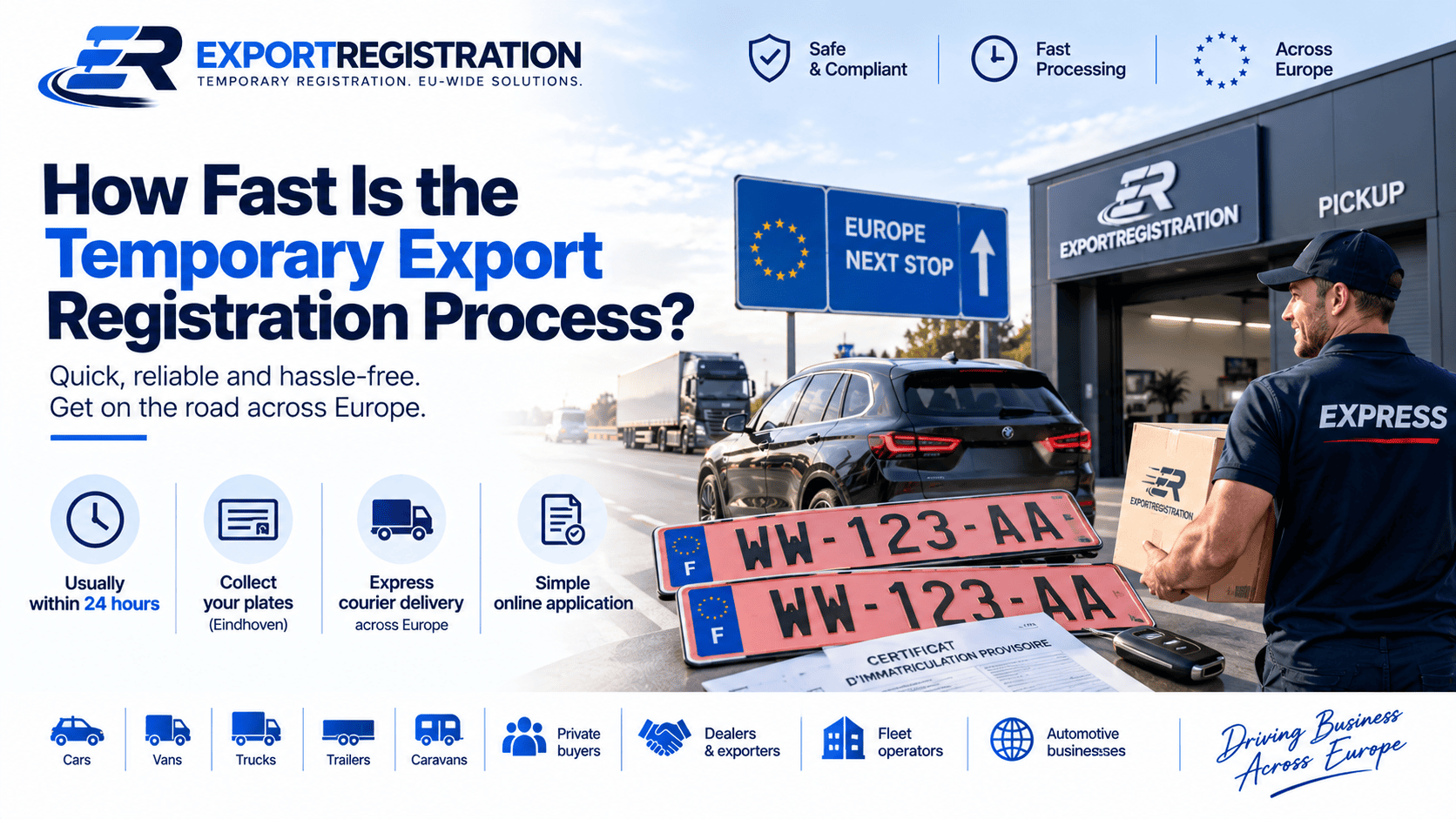
  • How Fast Is the Temporary Export Registration Process?

    How Fast Is the Temporary Export Registration Process?

    One of the most common questions customers ask is how quickly a temporary export registration can be completed.

    For most complete applications, ExportRegistration generally processes the registration within 24 hours.

    The actual total time can depend on the documents provided, the vehicle, the selected registration option and whether additional checks are required.

    What does “processed within 24 hours” mean?

    The 24-hour processing period generally starts once the application is complete.

    This means that the required information and documents have been received and can be processed without additional clarification.

    A complete application typically includes:

    Valid identification

    Vehicle registration documents

    Purchase or sales invoice

    VIN or chassis number

    Buyer and seller information

    Any required authorisation documents

    Selected registration options

    Insurance information where applicable

    If information is missing or inconsistent, processing may take longer.

    What can delay an application?

    Common reasons for delay include:

    Unreadable documents

    Missing pages

    Incorrect VIN

    Different names on documents

    Missing purchase information

    Incomplete buyer or seller details

    Missing authorisation

    Insurance information that still needs to be confirmed

    Additional verification by a registration partner

    System or authority delays

    Providing clear and complete documents from the beginning is one of the best ways to avoid delays.

    Can the registration be completed the same day?

    In some cases, yes.

    Where the application is submitted early, all documents are complete and no additional checks are required, processing may be completed on the same working day.

    However, same-day completion cannot be guaranteed for every application.

    The general service level remains that complete applications are usually processed within 24 hours.

    What happens after the registration is ready?

    Once the registration process has been completed, the customer can receive the registration documents and, where ordered, physical export licence plates.

    The next step depends on the delivery method selected.

    Can I collect the export plates?

    Yes.

    Where collection is available, customers can collect the physical export licence plates once they are ready.

    Collection can be useful when the vehicle needs to leave quickly and the customer does not want to wait for delivery.

    Collection instructions are provided once the plates are ready.

    Can the plates be delivered?

    Yes.

    Physical export licence plates can also be sent by express courier.

    This is useful for customers who are not able to collect the plates in person or who are located in another region or country.

    Express delivery is separate from the registration processing time.

    This means that the application may be processed within 24 hours, after which the courier delivery time begins.

    How fast is express delivery?

    Express delivery times depend on:

    Destination country

    Courier service

    Time of dispatch

    Weekends and public holidays

    Local delivery conditions

    Customs or border procedures where relevant

    Once the shipment has been dispatched, the delivery time is determined by the selected courier service.

    Can I choose between collection and delivery?

    Yes.

    Customers can choose the available delivery option that best suits their situation.

    Depending on the application, this may include:

    Collection

    Express courier delivery

    Other available delivery arrangements

    The exact options may depend on the registration and plate service selected.

    What if I need the registration urgently?

    If timing is important, submit the application as early as possible and make sure all documents are complete.

    Before submitting, check that:

    All document pages are uploaded

    The documents are readable

    The VIN is correct

    Buyer and seller information is complete

    Insurance requirements are clear

    The correct vehicle type is selected

    The requested registration period is correct

    This significantly reduces the chance that additional information will be requested.

    Does insurance affect processing time?

    It can.

    Where temporary insurance is selected, the insurance application may require additional information or approval.

    If the customer arranges insurance independently, they remain responsible for ensuring that valid insurance is active before the vehicle is used on public roads.

    A temporary registration or licence plate does not automatically mean that insurance is active.

    Does the vehicle type affect processing time?

    Potentially.

    Cars and vans may require a different set of checks from trucks, trailers, semi-trailers or caravans.

    More specialised vehicles may require additional documentation depending on the registration procedure.

    For more information, read:

    Which Vehicles Can You Register for Temporary Export Registration?

    Can business customers process multiple vehicles?

    Yes.

    Dealers, vehicle exporters, fleet operators and other automotive businesses may submit applications for multiple vehicles.

    Each vehicle must still have its own correct documentation and vehicle information.

    For customers handling larger volumes, preparing complete documents in advance is especially important.

    What is the fastest way to complete an application?

    The fastest applications are usually those where:

    Customer uploads all documents immediately

    VIN is correct

    Buyer and seller information matches the documents

    Selected registration option is clear

    Insurance requirements have already been determined

    No additional verification is necessary

    Processing and delivery are two separate stages

    It is important to distinguish between:

    Registration processing time
    Usually within 24 hours for a complete application.

    and

    Plate delivery time
    Starts after the physical plates are ready and depends on collection or courier delivery.

    This distinction is especially important for customers planning a vehicle pickup or international transport.

    Plan your vehicle collection carefully

    If you are buying a vehicle abroad, avoid planning the final departure before the registration and, where required, the physical plates and insurance are ready.

    Even where an application is normally processed quickly, external factors may occasionally cause delays.

    Start your application

    To help avoid unnecessary delays, prepare your documents before starting the application.

    ExportRegistration generally processes complete applications within 24 hours.

    Once the plates are ready, you can use our collection service or have the plates sent by express courier.

    Start your application online at ExportRegistration.com

    Frequently asked questions

    How long does temporary export registration usually take?

    Processing time can vary depending on the vehicle, the documents provided and the registration procedure. Applications with complete and correct information can usually be processed faster than applications that require additional checks.

    What can make temporary export registration take longer?

    Missing documents, unclear uploads, incorrect VIN details, incomplete purchase information or additional verification can delay the process. Providing complete and accurate information from the start helps reduce delays.

    Can I apply for temporary export registration before collecting the vehicle?

    In many cases, yes. If you already have the required vehicle documents, purchase information and VIN, the application can often be started before collection so the registration process is already underway.

    Will I be contacted if information is missing?

    Yes. If additional information or documents are required, you may be contacted before the application can continue. Responding quickly helps prevent further delays.

    Can payment delays affect the registration process?

    Yes. You do not pay when submitting the application. We first review your documents and confirm the final price. We then send an invoice with a secure payment link. Late payment after invoicing may delay further processing.

    Can temporary export registration be processed the same day?

    In some cases, applications can be processed quickly when all required documents are complete and correct. Processing time still depends on the vehicle, verification requirements and the registration procedure.