Buying vehicles through European car auctions has become increasingly popular among car dealers, exporters and private buyers. Online auctions make it possible to purchase vehicles from another country without visiting the seller before the sale.
But after winning the auction, one important question remains: how do you get the vehicle home?
A vehicle purchased at auction may no longer have registration plates that can legally be used by the new owner. In that situation, temporary export registration can provide a solution for collecting and moving the vehicle before permanent registration takes place.
What Happens After You Buy a Car at Auction?
After payment has been completed, the auction company or seller normally provides the vehicle documents and purchase information required for collection.
Before arranging transport, it is important to check whether the vehicle still has a valid registration that may legally be used for the journey.
In many cases, auction vehicles are deregistered or sold without usable registration plates.
That means temporary registration or professional vehicle transport may be needed before the vehicle can leave the auction location.
What Is Temporary Export Registration for an Auction Vehicle?
Temporary export registration gives the vehicle a temporary registration for a limited period.
It can be useful when a vehicle has been purchased in one European country and will later receive permanent registration in another country.
Through ExportRegistration.com, temporary registration can be valid for up to 4 months, depending on the registration option used.
This provides additional time for collection, cross-border transport and permanent registration at the vehicle’s final destination.
Which Documents Do You Need?
The exact documents can depend on the application, but customers will normally need information that identifies both the vehicle and the buyer.
Commonly required information includes:
valid ID or passport;
vehicle registration documents;
auction invoice or purchase invoice;
VIN or chassis number;
buyer or company information;
address details;
company and VAT details for business customers where applicable.
A Certificate of Conformity (COC) is not required for temporary export registration applications processed through ExportRegistration.com.
A vehicle inspection certificate is also not required to submit the application.
Check the VIN Before Applying
The VIN is one of the most important details in an auction vehicle application.
Before submitting your registration request, compare the VIN on the auction invoice with the vehicle registration documents.
The information should match exactly.
Incorrect VIN information can result in additional verification and may delay processing.
Can You Apply Before Collecting the Auction Vehicle?
In many cases, yes.
Once the auction has supplied the invoice, VIN and vehicle registration documents, the temporary registration application can often be started before travelling to collect the vehicle.
This can be particularly useful when the auction location is hundreds of kilometres away.
Preparing the registration in advance can reduce the risk of arriving at the collection location without the documents needed to move the vehicle.
Temporary Export Plates and Insurance
Temporary registration and vehicle insurance are separate.
If the auction vehicle will be driven on public roads, valid insurance must be active for the journey.
The insurance period should be checked separately from the registration validity period.
If the vehicle is being transported on a trailer or vehicle transporter instead of being driven, different requirements may apply.
What If the Auction Vehicle Has No Valid Inspection?
A valid inspection certificate is not required to submit the temporary export registration application through ExportRegistration.com.
However, temporary registration does not automatically make a vehicle roadworthy.
If a vehicle is damaged, unsafe or otherwise not permitted to be driven on public roads, it should be transported rather than driven.
Temporary Registration for Professional Car Dealers
Car dealers often purchase multiple vehicles from auctions in different European countries.
For professional buyers, handling every vehicle through a structured registration process makes administration easier.
Each vehicle can have its own VIN, auction invoice, registration documents, insurance selection and delivery information.
ExportRegistration.com supports both individual vehicle applications and businesses processing multiple registrations.
Online Car Auctions and Cross-Border Vehicle Trading
Online vehicle auctions have made the European automotive market increasingly international.
A dealer in one country can purchase a vehicle located hundreds or thousands of kilometres away and arrange collection without ever visiting the auction before purchase.
That makes temporary registration an important part of cross-border vehicle logistics.
Preparing the documents before collection helps connect the purchase process with the vehicle’s physical transport.
Start Your Temporary Export Registration Before Collection
If you have purchased a vehicle through a European auction, you do not necessarily have to wait until collection before starting the registration process.
Once the required purchase and vehicle documents are available, you can submit your application online through ExportRegistration.com.
Upload the documents, provide the VIN and applicant information, and select the required registration option.
Can I apply for temporary registration for a vehicle bought at auction?
Yes. Auction vehicles can be eligible for temporary export registration when the required vehicle, purchase and applicant documents are available.
Do I need the original auction invoice?
You need documentation confirming the vehicle purchase. A clear digital copy of the auction or purchase invoice can be uploaded as part of the application.
Can I apply before collecting the car?
In many cases, yes. If the VIN, invoice and vehicle registration documents are already available, the application can often be started before collection.
Do I need a COC for an auction vehicle?
No. A Certificate of Conformity is not required for temporary export registration applications processed through ExportRegistration.com.
Does the auction vehicle need a valid inspection certificate?
No inspection certificate is required to submit the temporary export registration application. Whether the vehicle itself may legally be driven is a separate matter.
How long can temporary export registration be valid?
Temporary export registration can be valid for up to 4 months, depending on the registration option used.
A temporary export registration can often be arranged quickly, but incomplete or incorrect information can delay an application.
ExportRegistration generally processes complete applications within 24 hours. Preparing the correct documents and checking the vehicle information before submitting your application can help prevent unnecessary delays.
This guide explains the most common points to check before applying.
Check the VIN carefully
The Vehicle Identification Number, also known as the VIN or chassis number, is one of the most important details in a temporary registration application.
For most modern vehicles, the VIN contains 17 characters.
Always compare the VIN entered in the application with the number shown on the vehicle registration documents and the vehicle itself.
Even one incorrect letter or number may cause the application to be delayed or require correction.
Upload clear vehicle documents
Vehicle registration documents must be clearly readable.
Make sure all relevant pages or parts of the registration certificate are uploaded.
Avoid photographs that are blurred, dark, cropped or covered by reflections.
If a document contains information on both sides, upload both sides where required.
The buyer or applicant may need to provide a valid passport or identity document.
Make sure the document has not expired and that all required information is clearly visible.
If an identity card has information on both the front and back, both sides may be required.
The personal information entered in the application should match the identification document.
Check the purchase or sales invoice
The invoice or sales document should clearly identify the vehicle and the parties involved in the transaction.
Important information should normally include the buyer, seller and vehicle details.
The VIN on the invoice should match the VIN on the vehicle documents and application.
Differences between documents can result in additional checks.
Enter buyer and seller information correctly
Names, addresses and company information should be entered accurately.
For business customers, check that the company name, VAT information and address are correct where required.
Using information that differs from the uploaded documents may cause unnecessary delays.
Select the correct vehicle type
ExportRegistration supports temporary export registration for different vehicle categories, including cars, vans, trucks, trailers, semi-trailers and caravans.
Selecting the correct vehicle category is important because document and registration requirements can differ between vehicle types.
If you are unsure which category applies to your vehicle, contact ExportRegistration before submitting the application.
Decide how the vehicle will be insured
A vehicle must have valid motor insurance before it is driven on public roads.
Customers may select temporary insurance through ExportRegistration where available, or arrange their own valid insurance.
If you arrange insurance yourself, make sure the insurance covers the correct vehicle and the period during which you intend to drive it.
The validity period of a temporary registration does not automatically mean that insurance is valid for the same period.
Check the insurance dates before travelling
Always check the start and expiry dates of the insurance before using the vehicle.
For example, a temporary registration may still be valid while the insurance has already expired.
Once the insurance expires, the vehicle must not be driven on public roads unless new valid insurance has been arranged.
Check the rules for your journey
Temporary registration systems can differ between European countries.
Before travelling, customers should check that the registration, licence plates, insurance and vehicle documents meet the requirements of the countries through which the vehicle will travel.
Rules and enforcement practices can change, so this should be checked before departure.
Respond quickly if additional information is requested
Sometimes additional documents or information may be required after an application has been submitted.
Responding quickly helps prevent the application from being placed on hold.
Always monitor the email address used for the application.
Review everything before submitting
Before completing your application, check that the information entered matches your documents.
Pay particular attention to the VIN, customer name, vehicle details, registration documents, invoice and insurance information.
A few minutes spent checking the application can prevent much longer delays later.
How quickly can an application be processed?
ExportRegistration generally processes a complete application within 24 hours.
Processing may take longer if documents are missing, information does not match, additional checks are required or an external registration partner or authority requires further information.
The fastest applications are those that are complete and correct when submitted.
Start your temporary export registration
Preparing your documents in advance makes the temporary registration process faster and easier.
With ExportRegistration, you can complete your application online, upload the required documents securely and select the available registration, insurance and licence plate options for your vehicle.
Customers who already have valid motor insurance may arrange their own insurance instead.
What are the most common reasons for delays in temporary export registration?
Delays are often caused by incomplete documents, unclear scans, incorrect VIN details, missing purchase information or mismatched customer data. Checking all information before submitting the application can help prevent unnecessary delays.
Can an incorrect VIN delay my temporary export registration?
Yes. The VIN must match the vehicle and the supporting documents exactly. Even a small error can cause the application to require additional verification or correction before it can be processed.
How can I make my temporary export registration application faster?
Prepare all required documents in advance, upload clear and complete copies, check the VIN carefully and make sure the buyer, seller and vehicle information is correct before submitting the application.
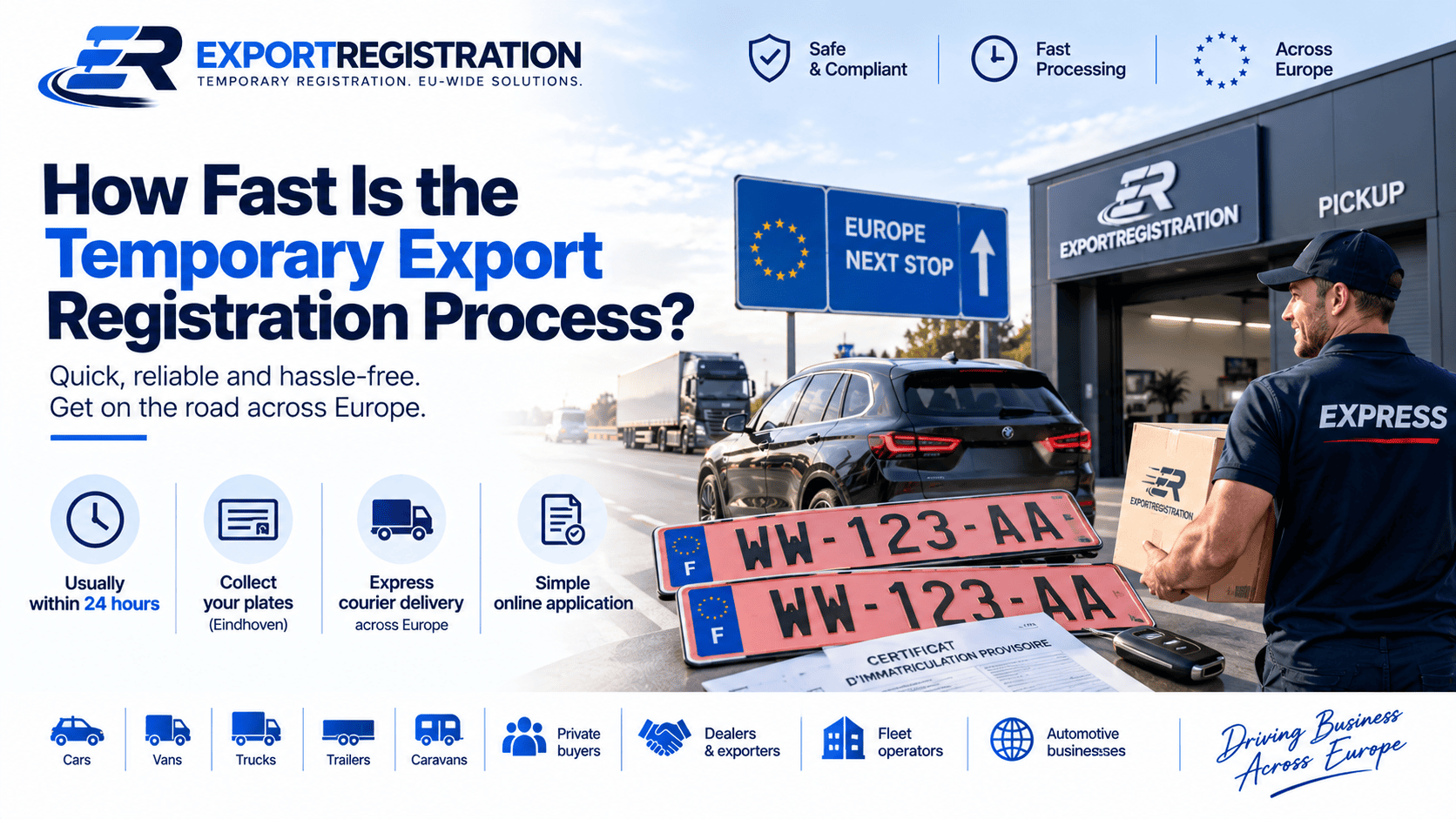
One of the most common questions customers ask is how quickly a temporary export registration can be completed.
For most complete applications, ExportRegistration generally processes the registration within 24 hours.
The actual total time can depend on the documents provided, the vehicle, the selected registration option and whether additional checks are required.
What does “processed within 24 hours” mean?
The 24-hour processing period generally starts once the application is complete.
This means that the required information and documents have been received and can be processed without additional clarification.
A complete application typically includes:
Valid identification
Vehicle registration documents
Purchase or sales invoice
VIN or chassis number
Buyer and seller information
Any required authorisation documents
Selected registration options
Insurance information where applicable
If information is missing or inconsistent, processing may take longer.
What can delay an application?
Common reasons for delay include:
Unreadable documents
Missing pages
Incorrect VIN
Different names on documents
Missing purchase information
Incomplete buyer or seller details
Missing authorisation
Insurance information that still needs to be confirmed
Additional verification by a registration partner
System or authority delays
Providing clear and complete documents from the beginning is one of the best ways to avoid delays.
Can the registration be completed the same day?
In some cases, yes.
Where the application is submitted early, all documents are complete and no additional checks are required, processing may be completed on the same working day.
However, same-day completion cannot be guaranteed for every application.
The general service level remains that complete applications are usually processed within 24 hours.
What happens after the registration is ready?
Once the registration process has been completed, the customer can receive the registration documents and, where ordered, physical export licence plates.
The next step depends on the delivery method selected.
Can I collect the export plates?
Yes.
Where collection is available, customers can collect the physical export licence plates once they are ready.
Collection can be useful when the vehicle needs to leave quickly and the customer does not want to wait for delivery.
Collection instructions are provided once the plates are ready.
Can the plates be delivered?
Yes.
Physical export licence plates can also be sent by express courier.
This is useful for customers who are not able to collect the plates in person or who are located in another region or country.
Express delivery is separate from the registration processing time.
This means that the application may be processed within 24 hours, after which the courier delivery time begins.
How fast is express delivery?
Express delivery times depend on:
Destination country
Courier service
Time of dispatch
Weekends and public holidays
Local delivery conditions
Customs or border procedures where relevant
Once the shipment has been dispatched, the delivery time is determined by the selected courier service.
Can I choose between collection and delivery?
Yes.
Customers can choose the available delivery option that best suits their situation.
Depending on the application, this may include:
Collection
Express courier delivery
Other available delivery arrangements
The exact options may depend on the registration and plate service selected.
What if I need the registration urgently?
If timing is important, submit the application as early as possible and make sure all documents are complete.
Before submitting, check that:
All document pages are uploaded
The documents are readable
The VIN is correct
Buyer and seller information is complete
Insurance requirements are clear
The correct vehicle type is selected
The requested registration period is correct
This significantly reduces the chance that additional information will be requested.
Does insurance affect processing time?
It can.
Where temporary insurance is selected, the insurance application may require additional information or approval.
If the customer arranges insurance independently, they remain responsible for ensuring that valid insurance is active before the vehicle is used on public roads.
A temporary registration or licence plate does not automatically mean that insurance is active.
Does the vehicle type affect processing time?
Potentially.
Cars and vans may require a different set of checks from trucks, trailers, semi-trailers or caravans.
More specialised vehicles may require additional documentation depending on the registration procedure.
Dealers, vehicle exporters, fleet operators and other automotive businesses may submit applications for multiple vehicles.
Each vehicle must still have its own correct documentation and vehicle information.
For customers handling larger volumes, preparing complete documents in advance is especially important.
What is the fastest way to complete an application?
The fastest applications are usually those where:
Customer uploads all documents immediately
VIN is correct
Buyer and seller information matches the documents
Selected registration option is clear
Insurance requirements have already been determined
No additional verification is necessary
Processing and delivery are two separate stages
It is important to distinguish between:
Registration processing time Usually within 24 hours for a complete application.
and
Plate delivery time Starts after the physical plates are ready and depends on collection or courier delivery.
This distinction is especially important for customers planning a vehicle pickup or international transport.
Plan your vehicle collection carefully
If you are buying a vehicle abroad, avoid planning the final departure before the registration and, where required, the physical plates and insurance are ready.
Even where an application is normally processed quickly, external factors may occasionally cause delays.
How long does temporary export registration usually take?
Processing time can vary depending on the vehicle, the documents provided and the registration procedure. Applications with complete and correct information can usually be processed faster than applications that require additional checks.
What can make temporary export registration take longer?
Missing documents, unclear uploads, incorrect VIN details, incomplete purchase information or additional verification can delay the process. Providing complete and accurate information from the start helps reduce delays.
Can I apply for temporary export registration before collecting the vehicle?
In many cases, yes. If you already have the required vehicle documents, purchase information and VIN, the application can often be started before collection so the registration process is already underway.
Will I be contacted if information is missing?
Yes. If additional information or documents are required, you may be contacted before the application can continue. Responding quickly helps prevent further delays.
Can payment delays affect the registration process?
Yes. You do not pay when submitting the application. We first review your documents and confirm the final price. We then send an invoice with a secure payment link. Late payment after invoicing may delay further processing.
Can temporary export registration be processed the same day?
In some cases, applications can be processed quickly when all required documents are complete and correct. Processing time still depends on the vehicle, verification requirements and the registration procedure.
Temporary export registration is often used when a vehicle is purchased, sold or transported between European countries before permanent registration has been completed.
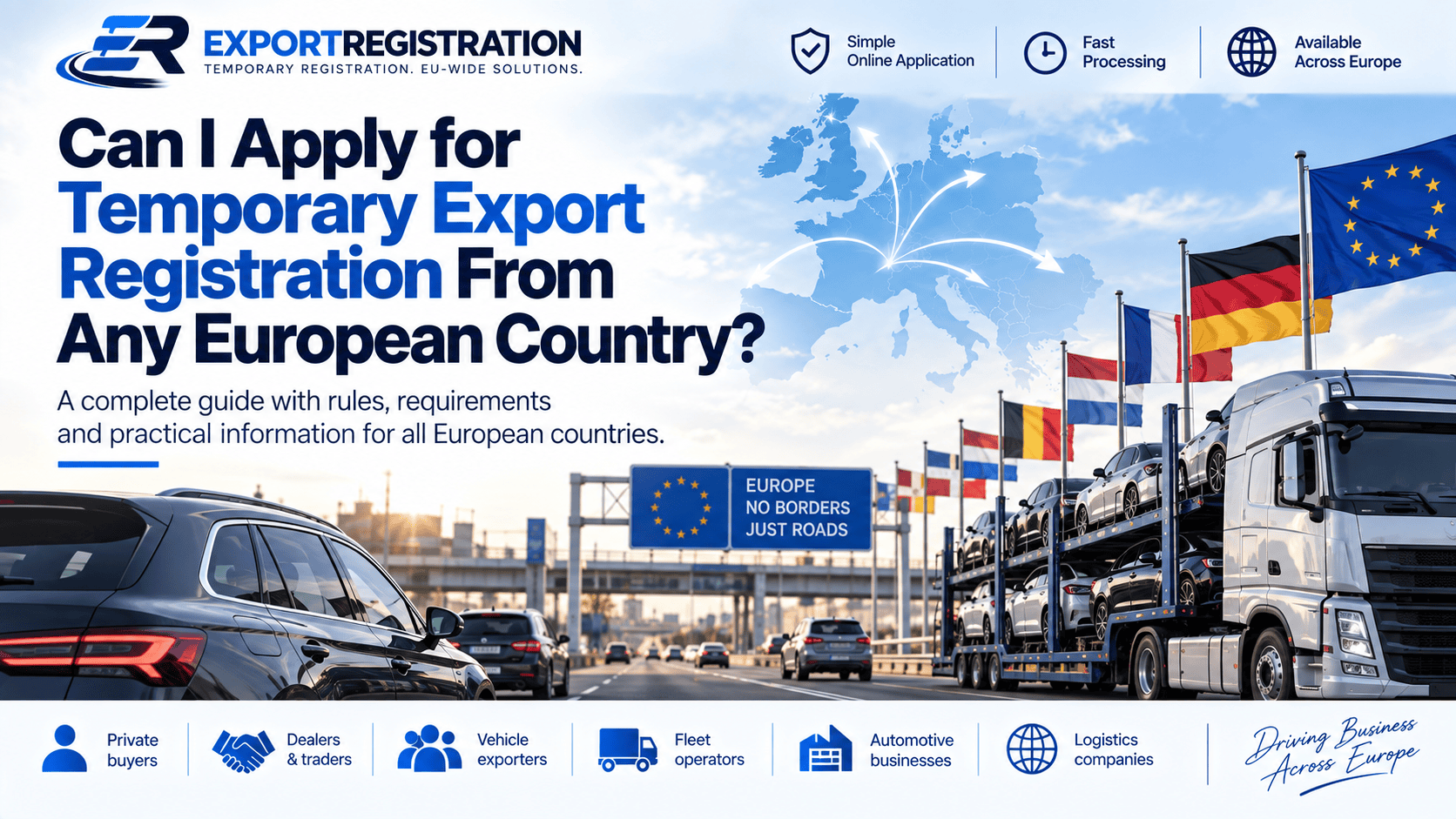
A common question is whether someone can apply from any European country.
The short answer is that customers from across Europe can submit an application online, but the availability of a specific temporary registration, licence plate or insurance option depends on several factors.
These include:
Country where the vehicle is currently registered
The country where the vehicle is located
Destination country
Vehicle type
The registration procedure being used
Insurance option required
The countries through which the vehicle will travel
Temporary vehicle registration is not fully harmonised throughout the European Union, which means national rules can differ. Official EU guidance confirms that there are no common EU rules covering all vehicle-registration procedures.
Can customers from all over Europe apply online?
ExportRegistration is designed to support private and professional customers throughout Europe.
This means an applicant may be located in a different country from the vehicle.
For example:
Belgian customer may purchase a vehicle in France.
Dutch dealer may sell a vehicle to a customer in Spain.
German vehicle may be purchased by a customer in another European country.
Transport company may move a vehicle between several countries before final registration.
The application itself can be completed online, but this does not automatically mean that every registration option is available for every vehicle or route.
Each application must be assessed based on the specific circumstances.
Does my country of residence determine whether I can apply?
Not always.
The country where you live is only one part of the application.
Other factors may be more important, such as:
Where the vehicle is registered
Where the vehicle is physically located
Who owns the vehicle
Where it was purchased
Where it will be permanently registered
Which temporary registration system is being used
Which insurance options are available
For that reason, two customers living in the same country may require completely different temporary-registration procedures.
What if the vehicle was purchased in another European country?
This is one of the most common situations.
vehicle may be purchased from:
private seller
dealership
vehicle auction
leasing company
fleet operator
commercial vehicle dealer
An exporter
When a vehicle is purchased abroad and needs to be driven home, temporary number plates and appropriate insurance may be needed.
Official EU guidance states that a temporary number plate can be used to drive a recently purchased vehicle from the country of purchase to the country where it will ultimately be registered. However, temporary plates are not mutually recognised throughout the EU, so the route must be checked in advance.
Can I apply if the vehicle is not in my country?
Potentially, yes.
It is entirely possible for the buyer, seller and vehicle to be located in different countries.
For example:
Buyer: Belgium
Vehicle: France
Seller: Netherlands
Destination: Spain
However, the available registration procedure depends on the documents, vehicle status and registration rules that apply to that particular situation.
ExportRegistration reviews the application based on the vehicle rather than simply the customer’s home address.
More information about the Belgian X plate and transit registration can be found on our page about the Belgian transit plate.
Can a business apply from another European country?
Yes.
Professional customers may also apply from different European countries.
This may include:
Vehicle dealers
Vehicle exporters
Fleet operators
Logistics companies
Transport companies
Automotive businesses
Truck dealers
Commercial vehicle companies
Businesses handling international vehicle sales
A business may be located in one country while regularly purchasing and selling vehicles throughout Europe.
Where a business acts on behalf of another customer, it must have the necessary authority to provide the customer’s information and documents.
Can a private buyer apply?
Yes.
Temporary export registration is not limited to professional vehicle businesses.
Private customers may also need temporary registration when buying a vehicle in another country.
A private applicant should normally have the relevant documentation available, including:
Valid identification
Vehicle documents
Purchase or sales invoice
VIN or chassis number
Buyer and seller information
Contact details
Any required authorisation
Additional documents may be required depending on the registration procedure.
Does the destination country matter?
Yes.
The destination country can affect:
Permanent registration requirements
Import formalities
Taxes
Vehicle inspection requirements
Insurance requirements
Documents needed after arrival
Temporary registration does not replace the permanent registration process in the destination country.
EU guidance explains that vehicle registration and taxation rules remain national and that specific conditions depend on the country concerned.
What about the countries I drive through?
This is extremely important.
The destination is not the only country that matters.
You must also consider every transit country on your route.
For example, if a vehicle travels from France to Poland, the route may pass through several other countries.
The temporary registration and insurance must be suitable for the journey.
Official EU guidance specifically warns that temporary number plates are not harmonised and recommends checking whether all countries on the route recognise the temporary plate.
Does ExportRegistration guarantee acceptance in every European country?
No.
No private registration service can guarantee how every police force, customs authority, registration authority or other government body will interpret or enforce rules in every European country.
Temporary registration systems can differ between countries and rules may change.
ExportRegistration processes registrations based on the procedures and information applicable at the time of the application.
The customer remains responsible for checking whether the registration, licence plates, insurance and vehicle documents are accepted for the intended route.
Can rules change after my registration is issued?
Yes.
National legislation, enforcement practices and administrative procedures can change.
A temporary registration that is validly issued under one country’s rules may later be affected by:
New legislation
Different enforcement practices
Border procedures
Insurance requirements
Changes in national registration policy
For that reason, customers should check current requirements shortly before travel.
Is insurance valid everywhere in Europe?
This depends on the specific insurance policy.
Compulsory third-party insurance is generally recognised when travelling within the EU, but customers must still verify the actual policy, territorial coverage and any conditions or exclusions. Official EU guidance advises drivers to check their insurance arrangements when travelling or moving between countries.
What Documents Do You Need for a Temporary Export Registration?
How long does an application take?
A complete application is generally processed within 24 hours.
Processing may take longer when:
Documents are missing
Information does not match
Additional verification is necessary
A registration partner requests further information
Insurance approval is required
An authority or external system experiences delays
Providing clear and complete documentation helps avoid unnecessary delays.
Can plates be delivered?
Where physical export licence plates are available, they may be collected or sent by express courier.
Delivery time is separate from application processing time and depends on the selected delivery service.
Before travelling
Before using a temporarily registered vehicle internationally, check:
Registration validity dates
Correct registration number, VIN and vehicle details
Insurance validity
Insurance territorial coverage
The countries on your intended route
Required vehicle documents
Roadworthiness requirements
Local road and registration rules
Customers should carry their registration and insurance documentation with them when travelling. EU guidance also recommends carrying insurance papers because they can make roadside checks or accident handling easier.
Can I apply for export registration if I live in another European country?
Yes, applications can often be started remotely from another European country, provided the required vehicle and applicant documents are available. The exact registration route depends on the vehicle and the countries involved.
Does the vehicle need to be located in the same country as the applicant?
Not necessarily. A vehicle may be purchased or located in a different country from the buyer. What matters is that the correct vehicle documents, ownership information and registration details are provided.
Can a private buyer apply for temporary export registration?
Yes. Temporary export registration can be relevant for both private buyers and professional vehicle traders who need to move a vehicle before permanent registration is completed.
Can businesses apply for export registration from another EU country?
Yes. Car dealers, exporters and other automotive businesses can submit applications for vehicles purchased or sold across European borders, subject to the required documentation and registration procedure.
Do I need to travel to the registration country to apply?
In many cases, the application process can be started online. Vehicle documents, identification and purchase information can be submitted digitally, although additional requirements may apply depending on the registration procedure.
Are the requirements the same in every European country?
No. Registration rules, required documents and temporary plate systems can differ between countries. The correct procedure depends on the vehicle, its current registration status and the countries involved.
Can I apply before I travel to collect the vehicle?
In many cases, yes. If you already have the VIN, purchase documents and registration papers, you can often start the application before collection.
Can I use temporary export registration to drive through several European countries?
This depends on the registration documents, insurance coverage and the countries on your route. Before travelling, make sure both the temporary registration and insurance are valid for the intended journey.
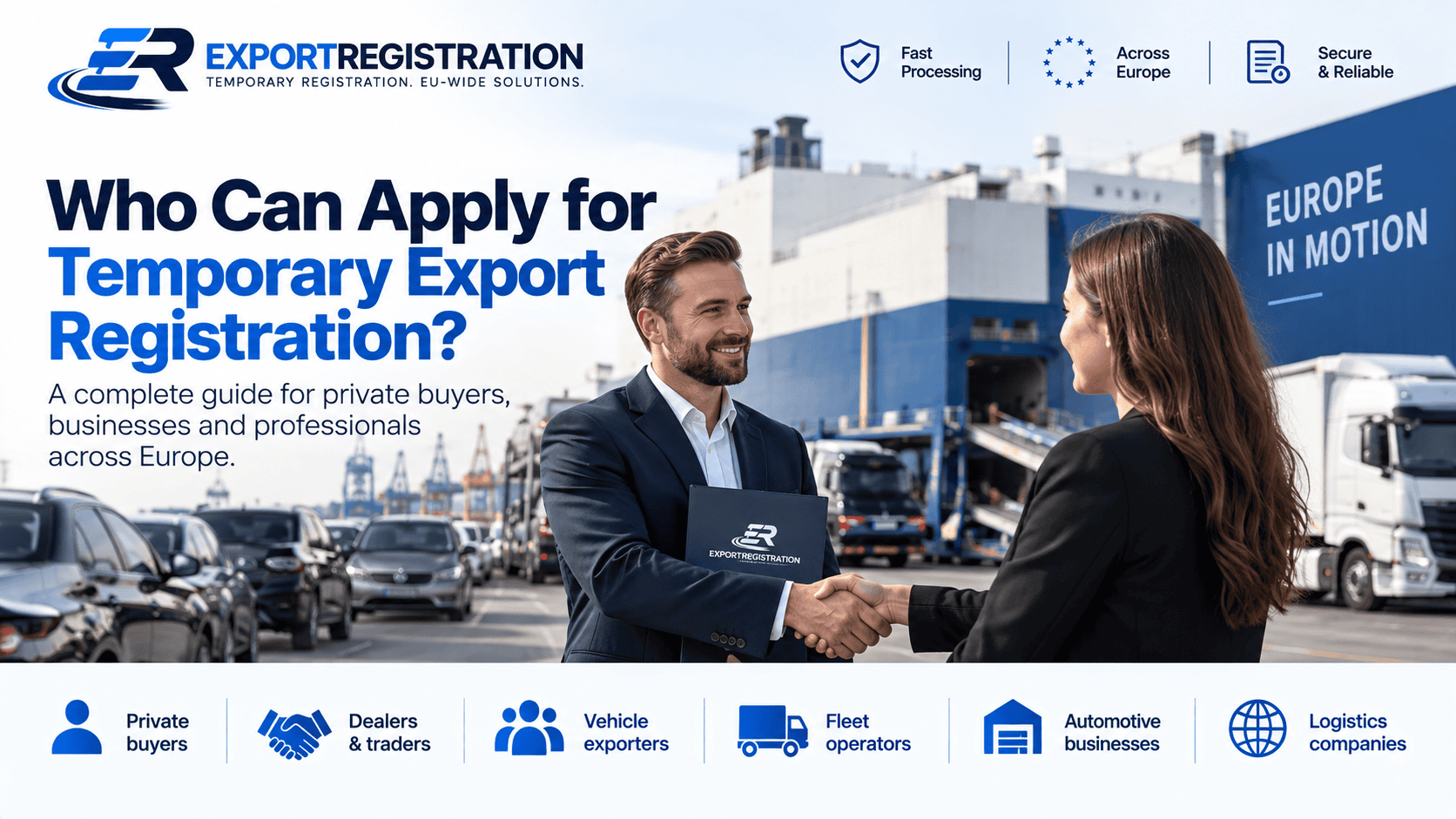
Temporary export registration is used in many different situations. It is not only intended for private buyers who purchase a vehicle abroad. Dealers, vehicle exporters, fleet operators, transport companies and other automotive businesses may also need temporary registration when a vehicle is sold, transferred or moved between countries.
This guide explains who can apply, when temporary export registration may be useful and what responsibilities apply when an application is submitted.
When is temporary export registration used?
Temporary export registration is generally used when a vehicle needs to be driven or transported before permanent registration in the destination country has been completed.
Typical situations include:
Buying a vehicle in another European country
Selling a vehicle to an international buyer
Exporting a vehicle to another country
Moving a company vehicle between countries
Transporting a vehicle before permanent registration
Delivering a vehicle to an international customer
Relocating a vehicle as part of a fleet
Moving a trailer, caravan or commercial vehicle between countries
The exact registration requirements depend on the vehicle, country of registration, destination and route.
Private buyers
Private customers can apply for temporary export registration when they purchase a vehicle abroad and need a temporary registration to move it to another country.
For example, a customer may purchase a vehicle from a dealer in one country and intend to permanently register it in another.
Before applying, the buyer should normally have access to the relevant vehicle documents and proof of purchase.
Depending on the registration procedure, the buyer may need to provide:
A valid passport or identity document
Purchase or sales invoice
Vehicle registration documents
Vehicle identification number (VIN)
Buyer and seller details
Address and contact information
Any additional documents required for the selected registration
Temporary insurance may also be required before the vehicle is used on public roads.
Customers buying from a dealership
Many international vehicle purchases take place through professional dealerships.
In these cases, the temporary registration may allow the buyer to collect or transport the vehicle before permanent registration has been completed in the destination country.
The dealership should provide the correct vehicle and sales documentation.
The buyer remains responsible for ensuring that the vehicle is legally permitted to travel through the countries involved.
Vehicle dealers and traders
Professional vehicle dealers frequently sell vehicles to international customers.
Temporary export registration can help bridge the period between the sale of the vehicle and permanent registration by the buyer.
Dealers may submit applications for individual vehicles or use the service repeatedly for international sales.
For professional customers, it is particularly important that:
Vehicle details are entered correctly
The VIN matches the registration documents
Buyer information is complete
Sales documentation is accurate
The applicant is authorised to submit the documents
Insurance arrangements are confirmed before the vehicle is used
Professional vehicle exporters
Vehicle exporters often process larger numbers of international transactions.
They may purchase vehicles from dealers, auctions, leasing companies, fleet operators or private sellers and then resell those vehicles in other countries.
Temporary export registration can form part of the export process where a vehicle needs to be driven or transported before permanent registration.
Professional exporters should maintain accurate records for each individual vehicle and customer.
Applications should never be submitted using documents from another vehicle or customer.
Automotive businesses
Temporary export registration can also be relevant for a wide range of automotive businesses.
This may include:
Vehicle dealerships
Used-car traders
Truck dealers
Commercial vehicle companies
Leasing companies
Fleet management companies
Vehicle auction businesses
Vehicle transport companies
Logistics providers
International vehicle exporters
These businesses may apply for their own vehicles or, where properly authorised, on behalf of their customers.
Fleet operators
Fleet operators may need temporary registration when vehicles are:
Sold at the end of a lease
Transferred to another country
Moved between company locations
Exported after fleet replacement
Delivered to a new owner
Because fleet transactions may involve multiple vehicles, accurate vehicle administration is especially important.
Each temporary registration is linked to a specific vehicle and must not be transferred to another vehicle.
Transport and logistics companies
Transport and logistics businesses are often involved in international vehicle movements.
However, the transport company is not automatically the owner or buyer of the vehicle.
Where a logistics company submits an application on behalf of another person or business, it must have the necessary authority to do so.
The relevant customer or vehicle owner remains responsible for providing correct documents and information.
Can an employee apply for a company?
Yes, an employee or representative may be able to submit an application on behalf of a company when they are authorised to do so.
Additional company information or authorisation may be requested where necessary.
The applicant should ensure that the person or company named in the application matches the supporting documents.
Can someone apply on behalf of another private person?
In some cases, yes.
A representative may be able to assist another person with the application, but they must have permission to act on behalf of the buyer or owner.
Depending on the registration procedure, a signed mandate or other proof of authorisation may be required.
Who is responsible for the information in the application?
The applicant is responsible for ensuring that all information and documents submitted are accurate and genuine.
This includes:
Names
Addresses
VIN or chassis number
Vehicle registration details
Buyer details
Seller details
Invoices
Identity documents
Authorisations
Insurance information
Incorrect information can result in delays, rejection, additional costs or problems during roadside checks.
Who is responsible for insurance?
Valid motor insurance must be in force before a vehicle is used on public roads.
Where temporary insurance is available through ExportRegistration, the customer may select that option.
If the customer does not purchase insurance through ExportRegistration, the customer remains responsible for arranging valid insurance independently.
The applicant should check:
Insurance start date
Insurance expiry date
Vehicle details
Registration number where applicable
Territorial coverage
Countries in which the insurance is valid
Any policy exclusions
A registration document or licence plate is not proof that valid insurance exists.
Who is responsible for checking foreign rules?
The person using or transporting the vehicle remains responsible for checking the rules in every country involved in the journey.
Temporary registration systems are not completely harmonised throughout Europe.
A registration that has been issued correctly in one country may be subject to different rules or enforcement practices elsewhere.
Before travelling, customers should check whether their:
Temporary registration
Licence plates
Insurance
Vehicle documents
Technical inspection
Vehicle condition
comply with the requirements of each country on the route.
Can an application be refused?
Yes.
An application may be refused, delayed or suspended when:
Documents are missing
Documents cannot be read clearly
Information does not match
The VIN is incorrect
Ownership cannot be demonstrated
Authorisation is missing
Fraud or document manipulation is suspected
An insurer or registration authority rejects the application
Submitting an application does not automatically guarantee approval.
Can businesses submit multiple applications?
Yes.
Professional customers such as dealers, exporters and fleet operators may submit applications for multiple vehicles.
Each vehicle must still have its own correct documentation and vehicle information.
ExportRegistration can support both individual customers and professional customers handling larger volumes of vehicle registrations.
What vehicles can be included?
Depending on the available registration procedure, ExportRegistration can assist with different vehicle categories, including:
Cars
Vans
Trucks
Trailers
Semi-trailers
Caravans
Different vehicle categories may require different documentation.
A complete application is generally processed within 24 hours.
The processing time may be longer if documents are incomplete, additional checks are necessary or an external registration or insurance partner requires further information.
Providing clear and complete documents from the beginning is one of the best ways to avoid delays.
Can licence plates be collected or delivered?
Where physical export licence plates are available, collection may be possible.
Plates may also be sent by express courier.
Delivery time is separate from registration processing time and depends on the selected delivery method and courier.
Who should use ExportRegistration?
ExportRegistration is designed for customers who want a structured online process for temporary vehicle registration.
Whether you are purchasing one vehicle abroad or regularly exporting vehicles as part of your business, preparing the correct information in advance helps make the registration process faster and easier.
You can start the application online, upload the required documents securely and select the available registration, insurance and plate options for your vehicle.
Can private individuals apply for temporary export registration?
Yes. Private buyers may apply when they need to move a vehicle before permanent registration is completed, provided the required vehicle and identification documents are available.
Can car dealers apply for temporary export registration?
Yes. Car dealers and vehicle traders can use temporary export registration for vehicles they purchase, sell or move across European borders.
Can companies apply for multiple vehicles?
Yes. Businesses that handle several vehicles can submit separate applications for each vehicle, with the relevant VIN, vehicle documents, buyer details and registration information.
Can a buyer apply if the vehicle is still located with the seller?
In many cases, yes. If the buyer already has the required purchase documents, VIN and vehicle registration information, the application can often be started before collection.
Can someone apply on behalf of a company?
Yes, an authorised representative can usually submit an application on behalf of a company, provided the correct company details and any required authorisation are supplied.
Do I need to own the vehicle before applying?
You will generally need documentation showing the purchase, ownership or authorised right to register the vehicle. The exact documents required depend on the registration procedure.
Can vehicle exporters use temporary export registration?
Yes. Professional vehicle exporters regularly use temporary registration when vehicles need to be moved before their final registration in another country.
When applying for a temporary export registration, having the correct documents ready helps prevent delays and makes the process much faster. The exact requirements can vary depending on the vehicle type, country of registration and destination.
ExportRegistration helps private customers, dealers and vehicle exporters arrange temporary export registration for cars, vans, trucks, trailers and caravans throughout Europe.
Which documents are usually required?
For most applications, you should have the following documents ready:
1. Identification document of the buyer
A valid identity card or passport is normally required.
For an identity card, upload the front and back.
For a passport, upload the page containing the photograph and personal details.
Make sure the document is clearly readable and still valid.
2. Purchase or sales invoice
You will normally need a purchase invoice, sales invoice or another document that proves the transfer or ownership of the vehicle.
The document should clearly show the buyer, seller and vehicle details.
Preparing your documents before starting the application can save time and help prevent delays.
You can complete the entire process online, upload your documents securely and select the available registration, insurance and plate options for your vehicle.
What documents do I need for a temporary export registration?
You normally need a valid ID or passport, the vehicle registration documents, a purchase invoice or sales agreement, the VIN or chassis number and the required customer or company details.
Do I need a purchase invoice?
Yes. A purchase invoice or sales agreement is required to confirm the vehicle purchase and the details of the buyer and seller.
Does the VIN need to be provided?
Yes. The VIN or chassis number is required and must match the vehicle registration documents.
Do I need to upload identification?
Yes. A valid ID card or passport is required so the applicant’s identity can be verified.
Do business customers need extra information?
Yes. Business customers should provide their company details and VAT number where applicable, together with the required vehicle and purchase documents.
Do I need proof of address?
Proof of address may be requested as part of the application, depending on the registration procedure and applicant details.
Can I upload all documents online?
Yes. The required documents can be uploaded digitally during the ExportRegistration.com application process.
Do the documents need to be originals?
Clear and complete digital copies can be uploaded for the application. Additional documents or verification may be requested if necessary.
We detected that you may prefer another language. Would you like to switch to:



 English
 Dutch
 German
 French
 Serbian
 Portuguese
 Ukrainian
 Polish
 Romanian
 Spanish
 Italian