Export a Car to Belgium
Buying a car in the Netherlands to register in Belgium? Agree with the seller who will arrange the Dutch export and whether you will drive the car home or collect it on a transporter.
Before collection, ask for the Dutch registration card and transfer code, or the corresponding paper documents. Keep the purchase invoice or sales contract. The buyer needs the export certificate (Part II) and the remaining Dutch registration document for registration in Belgium.
Arrange Dutch export documents in Eindhoven
Once the vehicle arrives in Belgium, a private buyer can declare it to Belgian customs using E705 in MyMinfin or at a customs office.
Belgian customs procedure for a car bought abroad
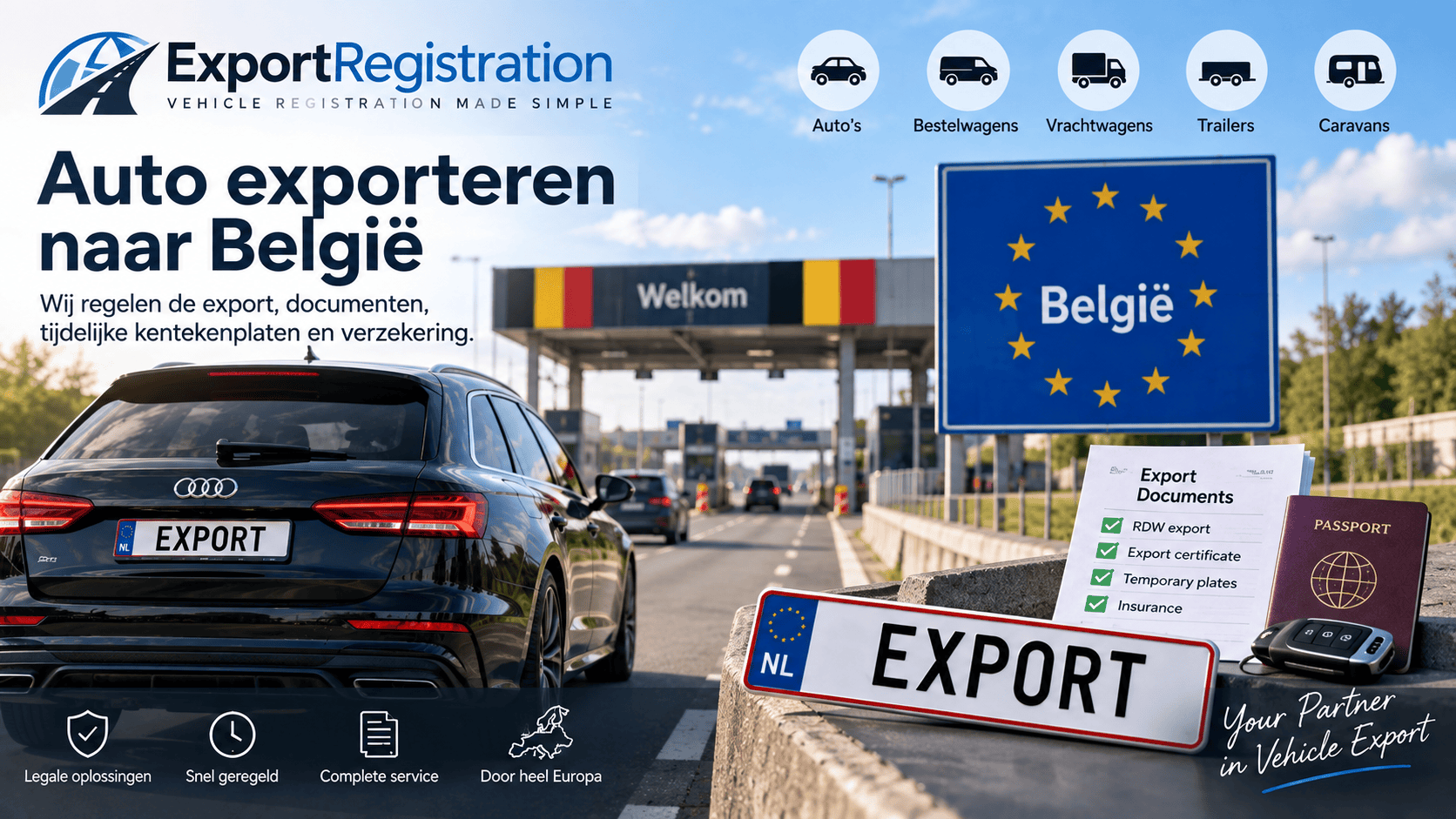
Exporting a Dutch Vehicle to Belgium
The Netherlands and Belgium have a large cross-border trade in used vehicles.
Belgian private buyers and professional car dealers purchase cars, vans and trucks in the Netherlands every day. After purchase, however, the vehicle still needs to be correctly exported from the Netherlands and ultimately imported and registered in Belgium.
These are two separate processes.
On the Dutch side, the Dutch registration must be terminated when a vehicle is permanently going to Belgium. The RDW refers to this as exporting the vehicle. With a standard export procedure, the customer receives, among other things, a certificate of indemnification and an export certificate, registration certificate Part II. This export certificate is required for registering the vehicle abroad.
ExportRegistration can help with this Dutch part of the process as well as with the temporary solution used to transport the vehicle to Belgium.
Deregister a Vehicle for Export with the RDW
Does the vehicle have a Dutch registration? Then we can arrange the RDW export deregistration.
During the export notification, the Dutch registration is removed from the normal registration system. The vehicle is then no longer registered in the name of the Dutch registration holder.
With a standard export procedure, the following are provided, among other things:
- a certificate of indemnification;
- the existing registration certificate;
- the export certificate / registration certificate Part II.
The RDW states that the export certificate together with the registration certificate is important for registering the vehicle abroad.
That is why it is important to complete the export correctly before the vehicle leaves the Netherlands.
Which Registration Do You Use to Drive the Vehicle to Belgium?
This is exactly where ExportRegistration looks beyond the RDW deregistration alone.
A Dutch export registration may be a suitable solution in certain situations, but we always assess whether it is the right choice for the specific application.
We work with different temporary registration and licence plate solutions.
For every application, we assess, among other things:
- where the vehicle is located;
- whether the vehicle has a Dutch registration;
- whether the vehicle will be driven to Belgium;
- the type of vehicle;
- who the buyer is;
- which vehicle documents are available;
- which insurance period is required;
- and which temporary registration is suitable for the planned journey.
We then look for a suitable available solution.
Dutch Export Registration to Belgium
Once a Dutch vehicle has been deregistered for export, the existing Dutch registration number can temporarily be used on white export plates.
According to the RDW, the vehicle may be driven on Dutch public roads for up to 14 days after the export notification using this export registration. For passenger cars, commercial vehicles and motorhomes, valid insurance and APK are required.
This does not automatically mean that it is the best solution for every export to Belgium.
That is why we always assess the complete journey and situation first.
Want to know more about the Dutch export procedure? Visit our page Apply for Export Registration in the Netherlands.
Different Temporary Registration Solutions
Not every vehicle going to Belgium is in the same situation.
A Belgian private buyer purchasing a car from a Dutch dealer, for example, has different needs from a Belgian trader collecting several vehicles from the Netherlands every week.
A vehicle from Germany or France may also ultimately be transported through Belgium.
ExportRegistration therefore does not work with only one type of plate.
Depending on the available documents and the situation, different temporary registrations can be considered.
Our aim is to find a suitable legal temporary registration solution that allows the vehicle to be transported in accordance with the conditions of that registration.
Temporary Belgian Transit Plate
Belgium also has temporary licence plates. Belgian regulations include X plates for export and W plates for certain temporary situations. The conditions depend strongly on the applicant, the vehicle and the circumstances; a Belgian temporary plate is therefore not automatically available for every import from the Netherlands.
That is why we assess per file which registration can actually be used.
We do not simply provide “a Belgian plate” or “a Dutch plate”; we first review the application.
Export Insurance for the Journey to Belgium
A temporary registration and insurance must match.
If you drive the vehicle yourself from the Netherlands to Belgium, it must be clear before departure that the vehicle is correctly insured.
For a Dutch export registration, for example, a passenger car, commercial vehicle or motorhome must be insured during the permitted driving period.
ExportRegistration can therefore also assist with arranging temporary export insurance.
The insurance required depends on the selected temporary registration and the period during which the vehicle will be driven.
Do you already have insurance that is valid for the vehicle and the temporary registration? Depending on the selected solution, we may also be able to work with those insurance details.
More information is available on our Export Vehicle Insurance page.
Importing a Vehicle into Belgium
The temporary export registration used to bring the vehicle to Belgium is not the same as the final Belgian registration.
After arrival, the vehicle must still be imported and registered in accordance with Belgian rules.
For a vehicle purchased outside Belgium, the E705 plays an important role. The Belgian Federal Public Service Finance describes the E705 as the electronic signal that allows the DIV to verify that the vehicle is lawfully present on Belgian territory.
For a vehicle purchased in another EU country, documents that may be required for the E705 include the purchase invoice or sales agreement, the latest registration certificate and identification.
After validation of the E705, the customs part of the process ends and the procedure continues towards the Belgian DIV.
Technical Inspection and Belgian Registration
Depending on the vehicle and the situation, a technical inspection may also be required before Belgian registration.
For certain used vehicles imported from another EU country, electronic registration through WebDIV may require, among other things, customs clearance, pre-registration and presentation for technical inspection.
This Belgian registration process is separate from the temporary registration solution used to transport the vehicle from the Netherlands to Belgium.
ExportRegistration focuses primarily on the export and transport part: the correct export deregistration, temporary registration, plates, documents and any required insurance.
Vehicle Purchased from a Dutch Car Dealer
Are you a Belgian customer buying a car from a Dutch dealer?
We can collect the required export details and prepare the Dutch export process.
You provide the vehicle details, sales invoice and requested identification documents.
We then check:
- whether Dutch RDW export deregistration is required;
- which temporary registration can be used;
- which licence plates are required;
- which insurance is required;
- how the documents and plates will be delivered.
This means you do not have to contact several different authorities and suppliers yourself.
Vehicle Purchased Privately in the Netherlands
We can also help when you purchase a car privately from a Dutch private seller.
In that situation, it is especially important that the export is completed correctly.
When selling to a foreign buyer, the RDW advises that the buyer exports the vehicle in their own name, so that the buyer’s details appear on the export certificate and it is clear who is responsible for the vehicle from that moment.
That is why we check the seller, buyer and vehicle details in advance.
Dutch Vehicle Purchased by a Belgian Dealer
For Belgian car dealers, speed is often even more important.
A vehicle that has to remain at the seller’s location for a week after purchase because registration, insurance or plates are missing costs time and money.
That is why business customers can submit their vehicle details and documents online.
We then assess which export and registration solution can be used.
For companies that regularly collect vehicles from the Netherlands, this process can be standardised.
Also for Vans and Trucks
This service is not limited to passenger cars.
ExportRegistration also processes applications for:
- vans;
- trucks;
- trailers;
- semi-trailers;
- caravans.
Especially in truck trading, longer distances and different vehicle categories may mean that a different registration or insurance solution is required.
That is why we assess these applications separately.
Transporting a Vehicle to Belgium
Will the vehicle not be driven itself, but transported entirely to Belgium on a car transporter or trailer?
Then the required solution may be different.
In that case, a temporary registration for driving the vehicle may not be necessary.
That is why we always ask during the application how the vehicle will be transported.
This helps prevent the customer from paying for plates or insurance that are not required for the selected transport method.
How Does Exporting a Vehicle to Belgium Work Through ExportRegistration?
1. Start the application
Enter the vehicle, buyer and seller details online.
2. Upload the documents
Upload the requested vehicle documents, invoice and identification details.
3. We review the file
We check where the vehicle is located, where it is going and which registration is required.
4. RDW export if required
For a Dutch vehicle, we can arrange the export deregistration.
5. Temporary registration solution
We assess which available temporary registration fits the vehicle and the journey to Belgium.
6. Insurance
If required, we arrange or verify the temporary insurance.
7. Licence plates and documents
The licence plates and documents are prepared for delivery or collection according to the available method.
8. To Belgium
The vehicle can then be transported to Belgium in accordance with the conditions of the selected registration.
What Happens After Arrival in Belgium?
The temporary export registration is intended for the transport and temporary use of the vehicle.
If you want to use the vehicle permanently in Belgium, it must then be imported and registered in accordance with Belgian rules.
For a vehicle purchased in another EU Member State, the E705 step is generally relevant. For an E705 for a purchase within the EU, the Belgian Federal Public Service Finance mentions, among other things, the purchase invoice or sales agreement, the latest registration certificate and identification.
The further process may then continue to technical inspection, insurance and DIV registration, depending on the vehicle.
Why ExportRegistration?
Cross-border vehicle sales involve several different systems:
Dutch RDW export, export documents, temporary licence plates, insurance and then the Belgian import and registration process.
We aim to make the first part of this process clear and manageable.
Instead of automatically supplying one type of export plate, we assess the complete situation.
For each vehicle, we look for a suitable temporary registration and licence plate solution for transport to Belgium.
Frequently Asked Questions About Exporting a Vehicle to Belgium
Yes. ExportRegistration can assist with Dutch export deregistration and the related export documents.
A Dutch export registration may form part of the solution depending on the situation. The RDW allows driving in the Netherlands for up to 14 days after the export notification; the registration and insurance conditions for the planned journey must also be checked.
If the vehicle is driven on public roads, the required insurance must be in place. Which insurance is required depends on the vehicle and the selected registration.
Yes. We consider different available temporary registration solutions and assess which one fits the application.
Whether a Belgian temporary plate is possible depends on the specific conditions of the Belgian system and the customer and vehicle details. We therefore assess this per file.
The E705 is an electronic signal that allows the Belgian DIV to verify that the vehicle is lawfully present on Belgian territory before registration.
For Belgian registration of a vehicle purchased outside Belgium, the E705 procedure is an important step. The exact formalities depend on the origin and circumstances of the vehicle.
This may be required. The procedure depends on the vehicle category, age, homologation and registration situation. For certain used EU import vehicles, the Belgian authorities explicitly include technical inspection as part of the registration process.
Yes. Our business service is specifically designed for customers who regularly buy and sell vehicles internationally.
Yes. We also process applications for vans, trucks, trailers, semi-trailers and caravans.
Export a Vehicle to Belgium
Bought a vehicle in the Netherlands and want to take it to Belgium?
Let ExportRegistration assess and arrange the RDW export deregistration, export documents, temporary registration solution and any required insurance.
We do not automatically provide the same export plates for every application. We assess which registration fits the vehicle, route and destination.
 English
 Dutch
 German
 French
 Serbian
 Portuguese
 Ukrainian
 Polish
 Romanian
 Spanish
 Italian