Deregister a Vehicle for Export with the RDW
Selling a Dutch-registered car abroad? At our counter at Boschdijk 1085, 5626 AG Eindhoven, we help you arrange RDW export deregistration through our registration partner.
Bring your valid ID, both original Dutch number plates and your registration card with its transfer code. If you have paper documents, bring the registration document Part 1B and the transfer certificate.
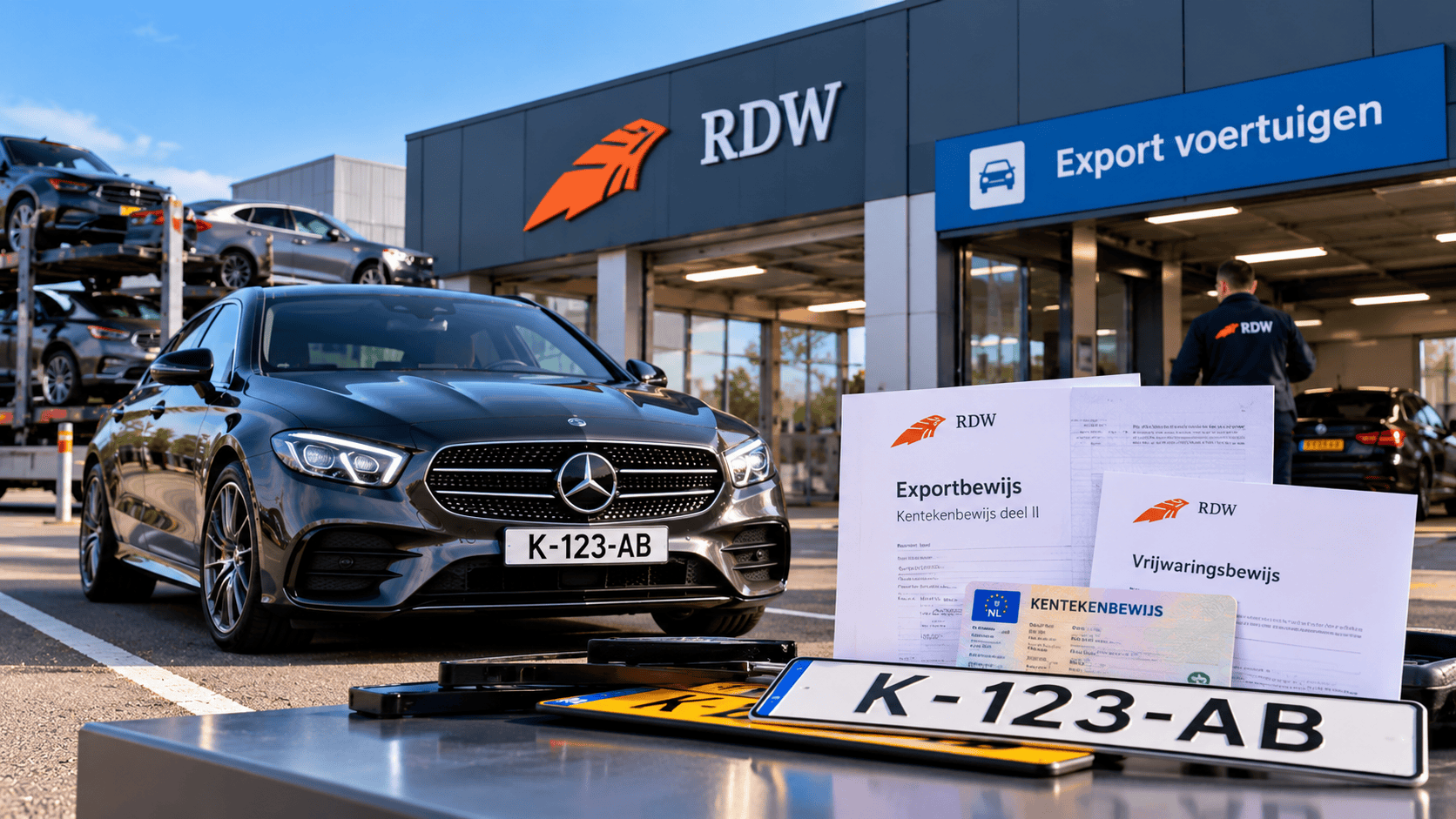
After deregistration, the seller receives proof of release from liability. The buyer needs the export certificate (registration certificate Part II) and the remaining registration document for registration abroad.
What Does It Mean to Deregister a Vehicle for Export?
A Dutch vehicle remains in the RDW vehicle registration system until it has officially been registered for export.
Simply selling the vehicle to a foreign buyer is therefore not enough.
Only after the export notification has been processed correctly does the Dutch registration end and the related vehicle obligations cease.
The RDW states that after the export notification, the Dutch insurance obligation, APK inspection requirement and motor vehicle tax obligation end for the Dutch registration. RDW
You also receive a certificate of indemnification as proof that the vehicle is no longer registered in your name.
Arrange RDW Export
A vehicle can be deregistered for export at:
- an RDW inspection station;
- an RDW service desk;
- or an authorised export company.
ExportRegistration can arrange the export process for customers and combine it with the required export documents, temporary licence plates and – if necessary – insurance.
This is especially practical when the vehicle still needs to be driven abroad after the sale.
Which Documents Do You Receive After RDW Export?
After a standard export notification, you receive important documents for both the seller and the foreign buyer.
The RDW issues, among other things:
Certificate of indemnification
Proof that the vehicle is no longer registered in the name of the previous Dutch registration holder.
Registration certificate
The existing registration card with one corner removed, or the old registration certificate Part 1B.
Export certificate – registration certificate Part II
Together with the registration certificate, this document is important for registering the vehicle abroad. RDW
Keep these documents safe.
Who Should Deregister the Vehicle for Export?
When you sell a vehicle to someone abroad, it is important to determine in advance in whose name the export will be processed.
The RDW advises sellers to have the foreign buyer export the vehicle in the buyer’s name.
The details of the person arranging the export are entered on the export certificate, registration certificate Part II.
If the seller arranges the export personally, the RDW states that the seller may remain responsible for the vehicle until it is registered abroad.
That is why it is important to complete the export procedure correctly.
Selling a Vehicle to a Foreign Buyer
Do you regularly sell vehicles to foreign dealers?
Then a correct RDW export notification is an essential part of every sale.
For example:
A Dutch dealer sells a car to a trader from Belgium, France, Spain, Portugal, Poland or Romania.
The buyer collects the vehicle in the Netherlands.
Before the vehicle leaves the Netherlands, the Dutch registration is deregistered for export.
The buyer then receives the export documents and, depending on the selected solution, can take the vehicle away by road or by transport.
Handing In Licence Plates for Export
During a standard export notification, the Dutch licence plates are taken in.
Authorised export companies must cut and retain the plates after the export notification in accordance with RDW rules. RDW
The original yellow Dutch licence plates therefore cannot simply be handed over for continued use after export.
If the vehicle still needs to leave the Netherlands by road after export, an export registration can be used.
Export Registration After RDW Deregistration
After the export notification, the vehicle may under certain conditions still be driven on Dutch public roads for a maximum of 14 days.
An export registration is used for this purpose.
The export registration uses the same registration number as the original Dutch registration, but with black letters and numbers on a white background.
Please note: these 14 days are the Dutch rules for use after export. For driving and use in other countries, it must be checked separately which registration, insurance and documents are accepted there.
Read more on our page Apply for Export Registration in the Netherlands.
Insurance After RDW Export
If the vehicle is still driven on public roads after the export notification, the required insurance must be in place.
For passenger cars, commercial vehicles and motorhomes, the RDW requires valid insurance and, where applicable, a valid APK during the Dutch export period.
Deregistering the Dutch registration therefore does not mean that the vehicle may then be driven without insurance.
As part of the export process, ExportRegistration can also assess a suitable temporary export insurance solution.
APK Inspection When Exporting
For passenger cars and commercial vehicles that continue to use Dutch public roads after the export notification, a valid APK is required.
If the vehicle is transported entirely on a trailer or car transporter, the situation is different because the vehicle itself is not participating in traffic.
That is why we always ask in an export application whether the vehicle:
will be driven abroad itself
or
will be transported.
How Long Can You Drive After Export?
After a Dutch export notification, the vehicle may be used in the Netherlands with the export registration for a maximum of 14 days, provided the applicable insurance and APK requirements are met.
This does not automatically mean that the same registration can be used for 14 days in every European country.
For international journeys, we therefore assess separately which registration and insurance are suitable for the planned route.
Exporting a Vehicle Immediately After Sale
In international vehicle trade, export often takes place immediately after the sale.
For example, a foreign dealer may buy a vehicle from a Dutch dealer in the morning and want to collect it the same day.
In such a situation, several steps can be completed one after another:
sale → RDW export notification → export documents → registration solution → insurance → departure.
By preparing these steps properly in advance, a foreign buyer can collect the vehicle more quickly.
RDW Export for Car Dealers
For professional vehicle companies, export is often part of daily business.
The RDW therefore has a separate Export Authorisation for companies that want to register vehicles directly for export in the vehicle registration system. RDW
When an export notification is processed under this authorisation, the following is carried out, among other things:
- the customer’s identity is verified;
- the vehicle is registered for export;
- registration certificate Part II is issued;
- a certificate of indemnification is provided;
- and the licence plates are taken in and destroyed. RDW
ExportRegistration also serves dealers that process multiple export vehicles each month.
Exporting a Vehicle from Dealer Stock
Vehicles held in a car dealer’s business stock can also be exported.
It is important that the required registration documents are available.
If the registration certificate for a vehicle in business stock is missing, a replacement registration certificate may under certain conditions be requested. The RDW indicates that this document may be required to register the vehicle abroad.
Therefore, check the documents before the vehicle is deregistered.
Registration Certificate Lost Before Export
Has the registration card or another required registration document been lost?
Preferably arrange this before the export notification.
The RDW warns that certain documents can no longer be requested in the same way after export and that they may be needed for registration abroad.
That is why we check in advance which vehicle documents are available.
Check the Requirements of the Destination Country First
A common mistake is to deregister a vehicle immediately and only afterwards find out which documents the destination country requires.
The RDW instead advises checking before the export notification which documents are needed to register the vehicle abroad.
This can differ from one country to another.
A vehicle going to Belgium may, for example, require different administrative steps from a vehicle being exported to Spain or Romania.
That is why we look not only at the Dutch export notification, but also at the planned destination.
Vehicle Already Abroad but Still on Dutch Registration
Sometimes a vehicle has already been taken abroad while the Dutch registration has not yet been terminated.
The RDW also has a procedure for this situation.
The owner can then submit a Report Export request and provide documents showing that the vehicle is actually abroad and will remain there.
The RDW currently states a processing time of up to 10 working days for this procedure.
However, with this procedure the owner receives no export certificate – registration certificate Part II.
If that document is required for registration abroad, the standard export procedure must be followed.
Exporting a Vehicle Outside the European Union
Is the vehicle going to a country outside the European Union or to an EFTA country?
In addition to the RDW export notification, a customs export declaration may also be required.
The RDW explicitly points this out for vehicles exported outside the EU/EFTA context.
This is a separate procedure from the vehicle registration export.
BPM Refund After Export
In certain situations, part of the BPM previously paid may be reclaimed after the permanent export of a vehicle.
Whether this is possible depends, among other things, on the vehicle, the registration date and the country in which the vehicle will be permanently registered.
The RDW refers to the Dutch Tax Administration for this.
The BPM refund is separate from the RDW export notification itself.
RDW Export for Trucks or Vans
The export procedure is not limited to passenger cars.
Dutch-registered:
vans, trucks, tractor units, motorhomes, motorcycles, trailers and other registered vehicles
can also be deregistered for export.
For heavy commercial vehicles, additional requirements concerning insurance, APK and international registration may apply.
More information is available on our page Truck Export Registration | Netherlands & Belgium.
How Does RDW Export Work Through ExportRegistration?
Step 1 — Submit Vehicle Details
Provide the Dutch registration number, vehicle details and the buyer and seller details.
Step 2 — Check the Documents
We check which registration documents are available and which documents are required for the export process.
Step 3 — RDW Export Notification
The vehicle is registered for export and the Dutch registration is terminated.
Step 4 — Export Documents
After the export notification, the relevant export documents and the certificate of indemnification are provided.
Step 5 — Registration and Insurance
Does the vehicle need to be driven abroad? We assess which registration and insurance solution is suitable for the planned route.
Step 6 — Vehicle Can Depart
Once the registration, documents and insurance are in order, the vehicle can be taken abroad in accordance with the applicable conditions.
Frequently Asked Questions About RDW Export Deregistration
When a Dutch-registered vehicle is permanently going abroad, the Dutch registration must be terminated by registering the vehicle for export.
Yes. After the standard export notification has been processed, the vehicle is no longer registered in the name of the previous Dutch registration holder. You receive a certificate of indemnification as proof.
You receive, among other things, a certificate of indemnification and an export certificate, registration certificate Part II. The existing registration certificate also remains part of the documents that may be needed for registration abroad.
In the Netherlands, this is permitted under certain conditions for up to 14 days with an export registration. For certain vehicles, insurance and a valid APK are required.
The vehicle keeps the same registration number, but during the Dutch export period it uses white plates with black letters and numbers.
Yes. During the standard export procedure, the Dutch licence plates are taken in. Authorised export companies must cut them after the export registration.
Yes. When selling to a foreign buyer, the RDW advises arranging the export so that the buyer’s details appear on the export certificate.
As part of an export application, we can assess which temporary insurance solution matches the selected registration and route.
Yes. There is a separate RDW procedure for this. Please note that with this route you do not receive export certificate Part II.
Yes. ExportRegistration is also set up for professional dealers and companies that regularly export multiple vehicles.
Deregister a Vehicle for Export with the RDW
Sold a Dutch vehicle to a foreign buyer?
Make sure the registration is correctly terminated before the vehicle permanently leaves the Netherlands.
ExportRegistration helps with RDW export, export documents, temporary licence plates and insurance for private and business vehicle export.
 English
 Dutch
 German
 French
 Serbian
 Portuguese
 Ukrainian
 Polish
 Romanian
 Spanish
 Italian