Import a Car from Belgium to the Netherlands
Driving it home? Send the Belgian registration documents, purchase invoice or sale agreement, destination and collection date. We check which temporary registration and insurance options are available for your journey to the Netherlands.
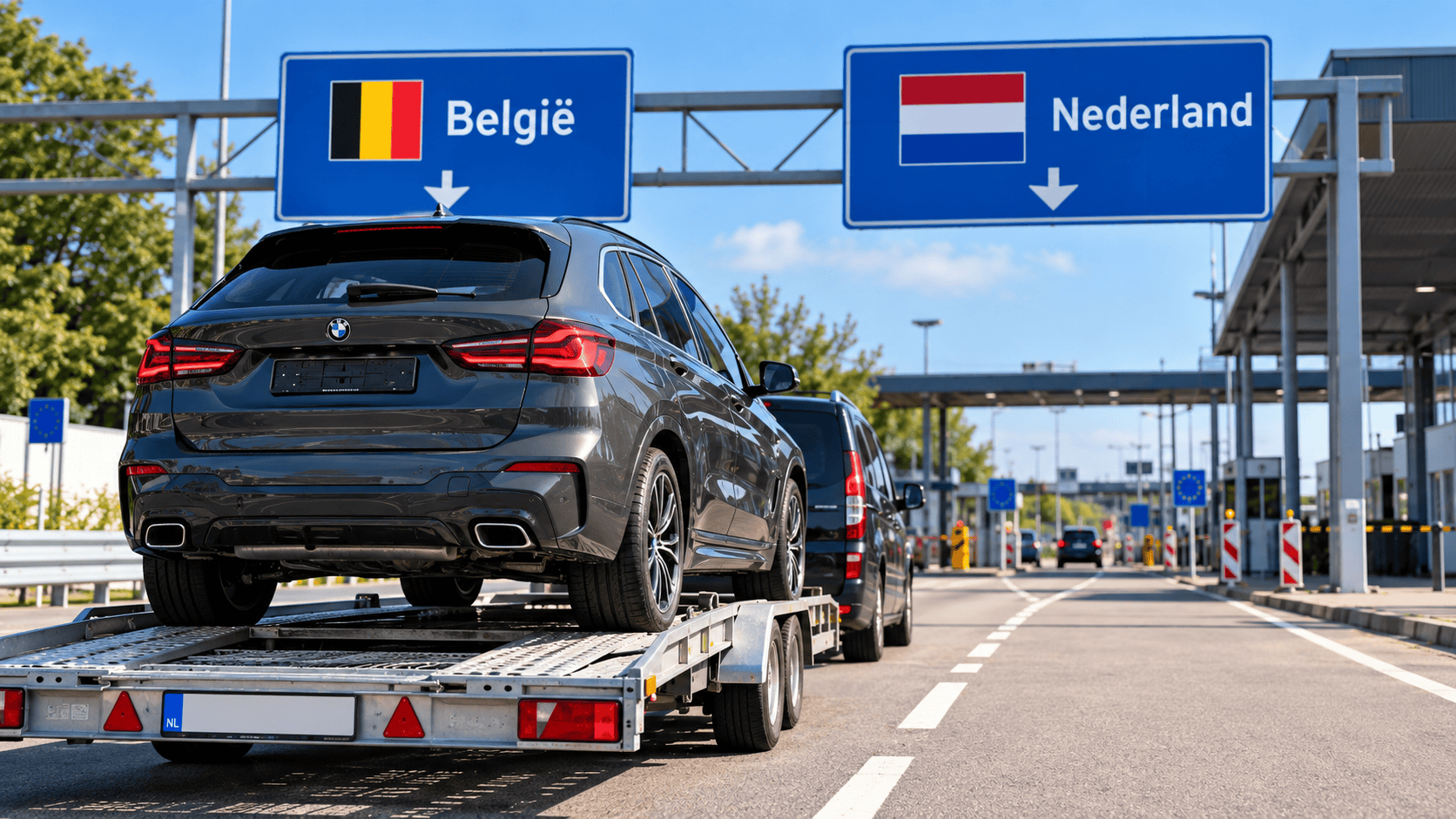
Using a trailer or car transporter? Tell us if the vehicle will be carried for the entire journey. We can then assess whether you need temporary registration for collection. Keep the original Belgian registration documents for the Dutch registration procedure.
Buying a Car in Belgium and Importing It into the Netherlands
Belgium is an attractive market for Dutch private buyers and vehicle dealers looking for used cars, vans and other vehicles.
However, after purchasing a vehicle in Belgium, you cannot simply drive it to the Netherlands.
Before departure, you need to determine which registration can be used, whether the vehicle is properly insured and which documents will be required for the final import and registration in the Netherlands.
The RDW explicitly states that it does not issue a licence plate that allows you to drive a vehicle from abroad to the Netherlands. The RDW advises arranging a valid solution in the country of purchase or transporting the vehicle on a trailer or vehicle transporter.
This is exactly the part of the process where ExportRegistration can help.
Temporary Registration from Belgium to the Netherlands
When a vehicle purchased in Belgium is driven to the Netherlands, a valid temporary registration must be in place before departure.
ExportRegistration therefore first reviews the complete vehicle file.
We look at the vehicle type, where the vehicle is located, the details of the buyer and seller, the country of destination, the vehicle documents, the required validity period and the available insurance options.
Based on this information, we look for a suitable temporary registration solution for the route from Belgium to the Netherlands.
Depending on the situation, this may be a Belgian temporary registration or another European temporary registration that is suitable for the specific vehicle and journey.
Belgian X Plate for Export
Belgium has an official temporary X plate for vehicles that are being exported.
According to the Belgian mobility authorities, the X plate is intended specifically for vehicle export and is normally valid for 30 calendar days. In certain situations, a different validity period may apply. The Belgian X plate is not automatically available for every buyer or every vehicle. Specific requirements apply to the applicant, documents, insurance and the vehicle. Belgian Mobility
For example, private buyers whose main residence is outside Belgium and certain companies from other EU countries may qualify for an X plate when purchasing a vehicle in Belgium for export. The DIV also processes these applications on the basis of original documents. Belgian Mobility
For that reason, we do not automatically provide the same plate for every vehicle purchased in Belgium.
We first determine which temporary registration is actually suitable and available for the specific file.
Multiple Temporary Registration Solutions
An important advantage of ExportRegistration is that we do not look at only one type of temporary registration.
In some situations, a Belgian X plate may be suitable. In other cases, another European temporary registration may be more practical, depending on the route, required validity period, vehicle documents and insurance.
For each application, we therefore assess which solution best matches:
vehicle → documents → buyer → route → validity period → insurance → destination.
This means a Dutch buyer does not have to compare different temporary registrations and insurance options from Belgium and other European countries independently.
Driving a Car from Belgium to the Netherlands Yourself
Do you want to collect the vehicle yourself after purchase?
Before departure, it must be clear that both the temporary registration and the insurance are valid for the planned journey.
The RDW can only carry out the Dutch registration procedure once the vehicle is in the Netherlands. A Dutch one-day registration, for example, is intended for driving to and from an RDW inspection station within the Netherlands and is therefore not a solution for driving a vehicle from Belgium to the Netherlands.
A suitable foreign temporary registration must therefore be arranged before the journey from Belgium, unless the vehicle is transported instead of driven.
Transporting the Car to the Netherlands by Trailer or Vehicle Transporter
The vehicle does not necessarily have to be driven to the Netherlands.
If the car is transported completely on a trailer, vehicle transporter or car carrier, the need for a temporary registration may be different.
That is why we always ask how the vehicle will be brought to the Netherlands.
For vehicles without a valid or suitable temporary registration, transport can be a practical alternative.
We want to prevent customers from arranging licence plates and insurance that are not necessary for their chosen transport method.
Temporary Insurance from Belgium to the Netherlands
A temporary licence plate does not automatically mean that the vehicle is properly insured.
For driving on public roads, the insurance must match the vehicle, the temporary registration, the insurance period and the countries through which the vehicle will travel.
For a Belgian X plate, the Belgian DIV requires proof of insurance, and the authorities also point out that not every insurer offers temporary insurance.
ExportRegistration can therefore also assess which temporary insurance solution is suitable for the application.
If you already have valid insurance for the chosen temporary registration, it may be possible to use it depending on the file.
More information is available on our Export Vehicle Insurance page.
Which Documents Do You Need When Buying a Vehicle in Belgium?
Make sure you receive the original vehicle documents before completing the purchase.
For the Dutch RDW import procedure, you must bring the complete original foreign registration certificate. A Certificate of Conformity, or COC, is not mandatory, but it can contain important technical vehicle information, including the CO₂ value that may be relevant for BPM.
The Car-Pass is also important when purchasing a vehicle in Belgium. The RDW states that a Belgian seller must provide a Car-Pass containing, among other things, information about the mileage. Since January 2025, the RDW also includes Belgian odometer readings in the RDW Vehicle Report. RDW
When purchasing a vehicle, therefore ask for the original Belgian vehicle documents, the purchase invoice or sales agreement and the Car-Pass.
Belgian Licence Plate After the Sale
A Belgian licence plate is linked to the registered holder and must be handled correctly after the sale.
Since August 2025, deregistration of a Belgian licence plate is handled directly by the DIV. The official rear plate with the DIV logo can be sent to the DIV or handed in in Brussels. As long as the plate has not been deregistered, obligations such as road tax and insurance may continue.
Do not simply use the seller’s existing Belgian plates for the journey to the Netherlands.
The transfer of the vehicle and the temporary registration for the buyer must be handled correctly.
Importing the Vehicle at the RDW
Once the vehicle is in the Netherlands, the second part begins: registering the vehicle on Dutch licence plates.
For a vehicle from an EU or EFTA country, you normally make an appointment at an RDW inspection station. The RDW identifies the vehicle and checks the original foreign documents. If everything is in order, the vehicle details are entered into the Dutch vehicle registration system. RDW
The RDW requires, among other things, the complete original foreign registration certificate and a valid identity document.
A valid foreign inspection certificate from an EU or EFTA country may, under certain conditions, be accepted. Inform the RDW and bring the original certificate with you. RDW
One-Day Registration for the RDW Inspection
Do you need to drive the vehicle to the RDW inspection station?
After making an RDW appointment, you can apply for a one-day registration for this purpose.
Important: this registration is intended for the Dutch RDW procedure. It is not intended for collecting the vehicle in Belgium.
After the RDW inspection, you may not simply continue driving the vehicle. The Dutch registration process must first be completed.
BPM When Importing from Belgium
For many vehicles imported from Belgium to the Netherlands, BPM may also apply.
For passenger cars, motorcycles and most light commercial vehicles, a BPM declaration may need to be filed after the RDW procedure.
The Dutch Tax Administration states that the BPM declaration for a vehicle purchased abroad can only be filed after the RDW has approved the vehicle and forwarded the vehicle data to the Tax Administration. Dutch Tax Administration
For used vehicles, the amount of BPM due may differ from that for a new vehicle.
Check the expected BPM before purchasing the vehicle so that you are not faced with unexpected costs afterwards. The RDW also advises import buyers to check this in advance. RDW
Dutch Licence Plates After Import
Once both the RDW and the Dutch Tax Administration have approved the registration, the Dutch vehicle registration process can be completed.
The RDW states that the new registration certificate is normally sent within five working days after approval. The full registration code follows separately. You can then have Dutch licence plates produced by an authorised licence plate manufacturer.
Before driving the vehicle on public roads, the mandatory Dutch third-party liability insurance must be active.
Bring a Valid Belgian Inspection Certificate
Does the vehicle still have a valid Belgian technical inspection?
Bring the original proof with you to the RDW.
The RDW may, under certain conditions, accept a still-valid periodic inspection from another EU or EFTA country. This can be demonstrated with the original inspection report or a valid entry on the foreign registration certificate.
This may prevent the need for an immediate full Dutch APK inspection.
Importing a Damaged Vehicle from Belgium
Damaged vehicles can also be imported from Belgium to the Netherlands, but additional requirements may apply.
For a vehicle with serious damage, the RDW may register a prohibition on driving on public roads. The vehicle must then be reassessed after repair before it can be driven normally on public roads.
Damage may also affect the BPM calculation and the required documentation.
If a vehicle cannot be driven safely or legally, transport on a vehicle transporter is generally more appropriate than a temporary registration solution.
Importing Vehicles from Belgium for Car Dealers
ExportRegistration also supports professional Dutch vehicle dealers who regularly purchase vehicles in Belgium.
For recurring imports, a predictable process is particularly important.
You provide the purchase invoice together with the vehicle and buyer details. We then assess which temporary registration is available for collection, which insurance fits the registration and how the licence plates can be delivered.
For companies purchasing multiple vehicles per month, we can standardise the application process as much as possible.
Importing Vans and Trucks from Belgium
Our service is not limited to passenger cars.
Vans, trucks, tractor units, trailers, semi-trailers and caravans are also regularly traded between Belgium and the Netherlands.
The final Dutch import procedure differs by vehicle category. The standard RDW EU import procedure does not apply in exactly the same way to all types of towed equipment and special vehicles.
That is why we also assess business and heavy-vehicle applications individually.
How Does Importing a Vehicle from Belgium to the Netherlands Work with ExportRegistration?
Step 1 — Purchase the Vehicle in Belgium
You purchase the vehicle from a Belgian private seller, dealer, auction or other company.
Step 2 — Submit the Documents
Send us the vehicle details, purchase invoice and required documents.
Step 3 — We Assess the Temporary Registration
We assess how the vehicle will be transported to the Netherlands and which temporary registration solution is available and suitable.
Step 4 — Temporary Insurance
If the vehicle will be driven to the Netherlands, we assess which insurance is required for the temporary registration.
Step 5 — Plates and Documents
After processing, the required registration documents, insurance documents and any licence plates are prepared.
Step 6 — Bring the Vehicle to the Netherlands
The vehicle can then be driven to the Netherlands according to the conditions of the chosen registration or transported instead.
Step 7 — RDW Import Procedure
In the Netherlands, the vehicle is registered with the RDW, or an approved company can use the applicable business RDW procedure.
Step 8 — BPM and Dutch Registration
If applicable, you file the BPM declaration. After approval, the Dutch registration can be issued.
Why ExportRegistration?
The difficult part of purchasing a vehicle in Belgium is often not only the final Dutch registration.
The problem starts before the vehicle even reaches the Netherlands:
Which plates can you use? Which registration do you need? Is the vehicle insured? How long is the registration valid?
The RDW itself does not issue a licence plate that allows you to drive the vehicle from Belgium to the Netherlands. RDW
This is exactly the part of the process that ExportRegistration supports.
We assess multiple temporary registration solutions and look for a suitable option based on the vehicle, documents, route and insurance.
Frequently Asked Questions
Do not automatically use the Belgian seller’s existing plates. The vehicle must have a valid registration and insurance that match the new situation. Which solution is possible depends on the specific file.
No. The RDW explicitly states that it does not issue a licence plate for driving a vehicle from abroad to the Netherlands. You must arrange a valid solution abroad or transport the vehicle.
The Belgian X plate is specifically intended for export and is normally valid for 30 days. Conditions apply to the buyer, vehicle, insurance and documents. Each application must therefore be assessed individually.
ExportRegistration works with multiple temporary registration solutions. We assess which available solution best matches the vehicle, route, documents and required validity period.
If the vehicle is driven on public roads, the required insurance must be active. The insurance needed depends on the chosen temporary registration.
A vehicle from another EU or EFTA country must be registered in the Netherlands through the RDW. The RDW identifies the vehicle and checks the documents. Certain approved businesses can use specific business procedures for used EU/EFTA vehicles.
Yes. For the standard EU import procedure, the RDW requires the complete original foreign registration certificate.
According to the RDW, a Certificate of Conformity is not mandatory for the standard EU import procedure, but it can be useful because it contains important technical information, including CO₂ data.
BPM may be due for passenger cars, motorcycles and most light commercial vehicles. The declaration is filed after the RDW has approved the vehicle.
The Car-Pass is important when purchasing a vehicle in Belgium. The RDW states that the Belgian seller must provide it, and since January 2025 Belgian odometer readings have also been included in the RDW Vehicle Report.
Yes. ExportRegistration is also set up for professional vehicle buyers and dealers who regularly bring vehicles from Belgium to the Netherlands.
Importing a Car from Belgium to the Netherlands
Bought a vehicle in Belgium and want to drive it to the Netherlands yourself?
Let ExportRegistration first assess which temporary registration, licence plates and insurance are suitable for the route from Belgium to the Netherlands.
The vehicle can then be imported in the Netherlands through the RDW and, where applicable after the BPM declaration, registered on Dutch licence plates.
 English
 Dutch
 German
 French
 Serbian
 Portuguese
 Ukrainian
 Polish
 Romanian
 Spanish
 Italian